It’s a bad time to be an empath, especially with the vast range of non-human life forms with whom we humans share the Earth.
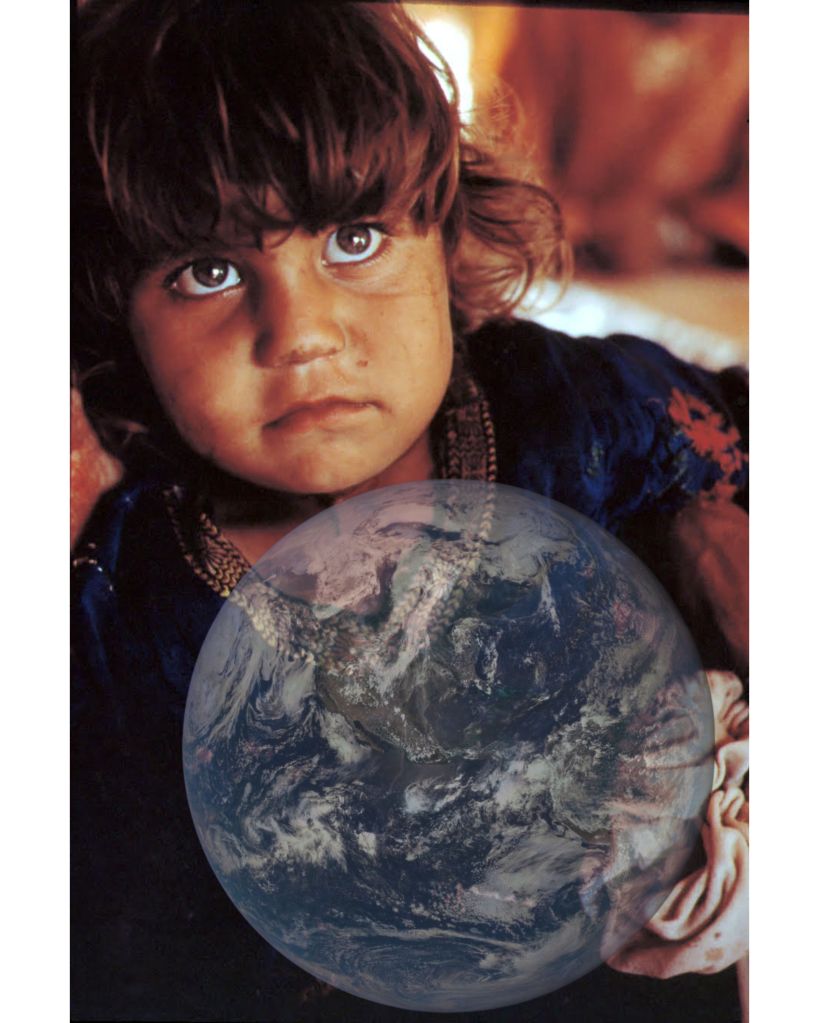
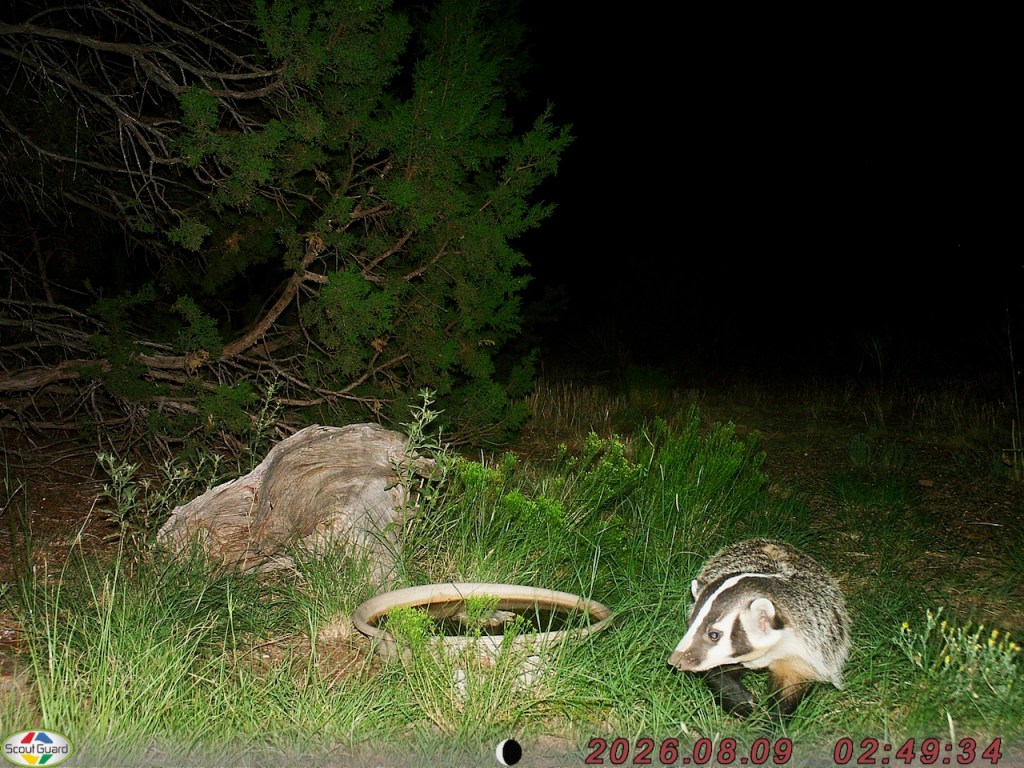
Who do I feel empathy with? Not just the suffering humans working outside in extreme heat and city pollution or wildfire smoke with no escape to cool air at home, but all the sentient beings affected by human-caused climate change. I am the tired badger resting by the bird water, the confused coyote pup, the thirsty bobcat, the wary rabbit wishing for water and not to be prey. I am the berryless juniper, the bare-branched Russian olive who once gave ample shade. I am the bear wandering desperately through the city in search of food, risking coming near dangerous humans.
Some rainless evenings I lean on my adobe wall and look out at the parched brown native grasses and the dusty land, and stream tears as I apologize to each species I can think of, one by one, naming them. I apologize for human hubris, and for those of us who have always seen this coming not (yet) being able to stop it, to reverse it, to harmonize it.
By now few would disagree that it’s been a horrendous summer in most of the northern hemisphere. There have been days when the temperature in London has been higher than the unusually hot temperatures here in Santa Fe. I think sometimes of the alternative life Timeline I might have chosen in the 80s when I was known as a journalist. Suppose I had stayed in the UK and gotten a job writing for the Guardian, or made documentary films for the BBC. How might my life have been different? Perhaps in many ways, but in the end I would be living in a drought-stricken heat-parched landscape, just as I am now in New Mexico.
The devastating, life-altering heat has been widespread. Japan now has a new weather designation, kokushobi which means “cruel heat day,” defined as days over 40 degrees C. This is the first summer that several cities have experienced those days.
I’ve lost count of how many “cruelly hot” days—which for our region I define as over 90F (32.2C) highs—that Santa Fe and environs have experienced this summer (actually, 56 as of August 20, according to this site). But what is worse and more frightening is the near absence of monsoon rains, the summer rains that cool the air and nurture the land.
There have been droughts before, even megadroughts. Prolonged drought is thought by many historians to be the main reason the Anasazi ancestors of the Indigenous Puebloan peoples who inhabit what is today called New Mexico mysteriously left sophisticated settlements and spiritual centers such as Chaco Canyon.
We have no way of knowing if today’s drought is worse than that of the 800s or the 1200s or the 1500s, but it is worse than the grueling 1950s drought and the Dust Bowl of the 1930s. Why? Because the baseline temperatures are much hotter than they were then, causing more evaporation and lower relative humidity. The increasingly drier land and its dead and dying vegetation is less likely to pull in the rain that could heal this vicious cycle.
Day after day, we peer at our weather apps, hoping against hope for some sign, anything, that the early July rains will finally reach us in late August, that the oppressive high pressure heat dome will dissipate, or move, or something. We squint at our phones, hoping all those 90+ degree numbers will somehow squiggle around and change and drop 10 degrees.
As a heat stroke survivor of decades, I unabashedly hate heat. The idea of being stuck in dangerous heat, or even heat that others may find bearable if unpleasant, terrifies me. The idea of having no escape from the sweltering, the sweating—and more dangerously, the absence of sweating that I experienced—leaves me near-paralyzed with fear.
And yet many of my friends are trapped in hot living spaces. I am privileged to have mini-split air conditioning, something we didn’t need 30 years ago when I first moved to Santa Fe. Then, an overhead fan and cross-breezes from cool evenings after afternoon rains were enough to cool off a house. My passive solar adobe, I have come to realize, was built for a climate that no longer exists, the overall dependable if variable climate we had for the last 5000 years until about 25 years ago. This house was scientifically-designed with just the right size overhang to prevent the sun from coming into the floor-to-ceiling solar windows during the height of summer and allow it in as the days cooled.
Except that the days aren’t cooling on schedule anymore. Nor are the nights. The 12 hours below 70 we used to routinely get in summer have been reduced to maybe 6, or on a good night 7 or 8. The merciless sun shines relentlessly onto my solar windows and is dutifully absorbed by the interior adobe Trombe walls I had first encountered in Ladakh in 1983. The absorbed heat radiating back into the house after dark was so welcome on a cold winter night.
Now the house overheats in winter. Actually the overheating starts in early August, when there used to be a slight chill in the night air and the sun’s lower path in the sky allows direct sunlight to shine on the windows. I’m glad for my thermal shades and their soft rose glow, though they no longer do enough to reduce the sun’s heat.
And last week a new torture hit: thick toxic smoke full of dangerous particulate matter from the Frijoles fire in the forest 50 miles north of here. I’m relatively insulated with mostly airtight windows and AC that doesn’t suck in smoke like the whole-house evaporative cooling unit I used to have. The increasing frequency of wildfire smoke is actually the main reason why I replaced it with mini-splits and increased the size of my rooftop solar array to support running the AC more frequently, earlier and later in the year, and sometimes 24/7.
No one has ever seen anything like this summer here. We’ve never had weeks and months of 90 degree plus highs, with Albuquerque seeing weather more like Phoenix, 10 days (so far) of 100 or over. When I first moved to Santa Fe in the mid-90s the average was only six days a year over 90.
Forgive me, dear reader, for succumbing to solastagia, the grieving for an environment that has changed around me, and definitely not for the better.
I look at old pictures and weep. The Russian olive tree only a few years old, not much taller than I, that became a shade tree for the whole garden and provided olives inedible to humans but that the robins loved. The ornamental plum, may her spirit rest in peace, with her sweetly-scented delicate blush-pink blossoms in spring and burgundy leaves all summer. The apple tree, still surviving as a thickly-leafed and mighty shade tree, but not bearing a single apple this year because she now blooms weeks earlier than 25 years ago and sometimes loses her fertilized blooms to withering late frosts, as happened this past April.
I haven’t seen a jackrabbit in years. Cottontails, who “breed like rabbits,” have been scarce because of various diseases. Small rodents like deer mice and desert wood rats (pack rats) seem to be thriving and at least provide some sustenance for the remaining coyotes, bobcats, badgers, snakes, and birds of prey—those who haven’t eaten the wrong mice and succumbed to secondary poisoning from the rodenticides that pest control companies convince uninformed residents are “safe” for the environment and won’t get into the food chain.
In past drought years, we always got at least a little bit of rain. This year I don’t even know why I own a rain gauge, let alone two different types and two weather stations. At 3.44 inches of rain measured since January 1st, we’re pretty much on par with the wetter parts of the Sahara and with the Himalayan rain shadow land of Ladakh, both of which historically have gotten 4 inches a year.
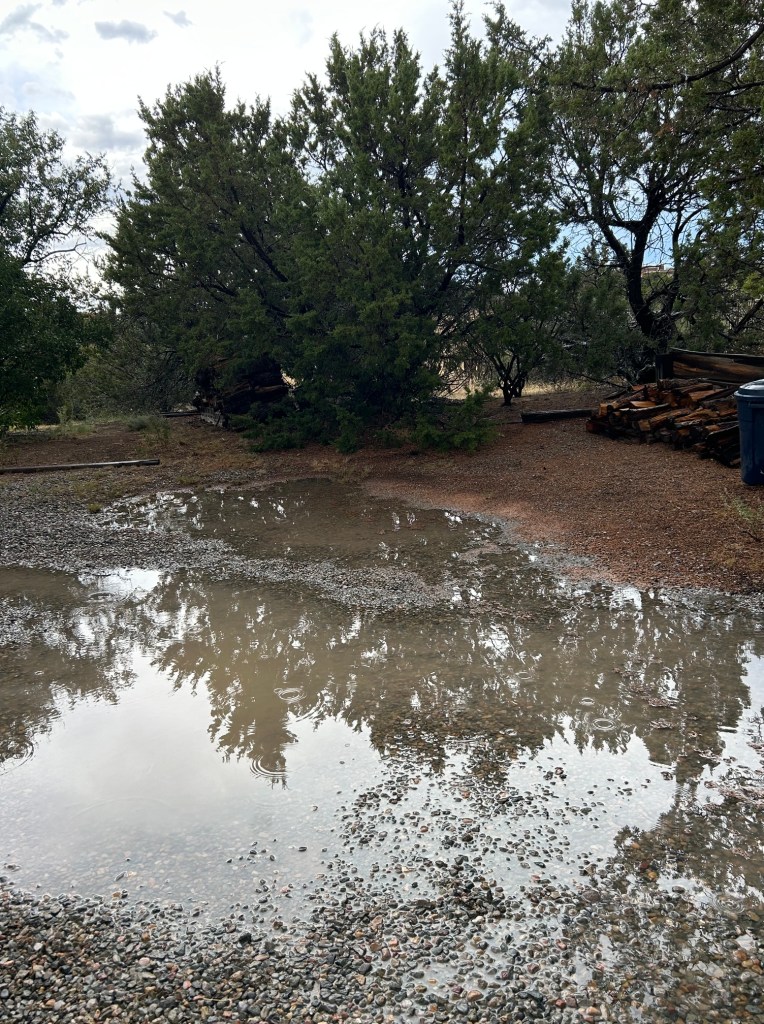
My semi-rural community outside Santa Fe has only had about two or three “decent” storms that dropped close to a quarter inch of rain. We didn’t experience one single deluge that leaves puddles in the graveled drive until an unpredicted old-fashioned glorious storm yesterday.
The Russian olive I have loved is half-dead. I had to have the branches that shaded the back yard for so many years removed. My handyman helped me put up a shade cloth to cover that part of the garden, which is being assaulted by the sun blazing from relentlessly cloudless skies, shriveling drought-resistant plants I’ve had for decades. The other day I noticed that the other half of the tree that shades the adobe garden wall, is not looking good either. But in an astonishing show of rebellious resilience, shoots are sprouting from the earth at the bottom of the venerable trunk. Usually I would remove the suckers to prevent them from sapping life force and water from the main trunks. But this year I’m letting them grow, in hopes that someday the tree will regenerate.
The hummingbirds who usually feast on the nectar of the trumpet vine and a variety of other flowers are drinking my feeders dry this year. For some reason they are avoiding the hummingbird mint (Agastache) they usually love. My research indicates that this might be because of the change in composition and taste of the nectar due to extreme heat and drought. At least the bumblebees and honeybees like it. Which is good because it’s the only thing blooming other than the many huge catnip bushes that I’ve let naturalize from a few organic plants 10 or 15 years ago. The two red-orange blooms that the trumpet vine produced this year have long ago shriveled and fallen off.
I’ve never seen deer in this area before, several miles from the foothills. But I’ve seen them this year on my night critter cam. Bears have come into the center of Santa Fe looking for food and water. How are they going to bulk up for winter—if we even get winter again? Bears are climbing electric poles and getting electrocuted, and getting hit on the interstate.
It’s much the same in parts of British Columbia. A bear recently mauled a toddler in Maple Ridge, near the house I rented last summer. Thankfully the child did not sustain life-changing injuries. But the Mounties shot the bear.
The ponderosa forest is on fire in New Mexico, not far from the high road to Taos and the sacred healing shrine at Chimayo. A friend there says that the ditches, the acequias that usually carry water for irrigation through the summer, are dry. Her trees are struggling, her roses and other flowers dying and shriveled to a crisp.
The same in happening in Canada, in interior BC, in northern Ontario. Drought grips the land in coastal rainforest and the boreal forest that covers much of the country. Smoke chokes cities, villages, countryside, and wilderness. Indigenous people who have contributed the least to greenhouse gases smothering our atmosphere are suffering the most. Some 42% of people forced to evacuate are First Nations, who are only 5% of Canada’s population.
And with wearying regularity we are hearing of vast and vicious wildfires in Spain, France—and, um, the fens of Suffolk in Britain and the Cairngorm mountains of the Scottish highlands where I saw ospreys nesting in a nature reserve after I spent Experience Week at the Findhorn Foundation.
Today’s Europe, warming at twice the global average rate (which is horrific enough), bears little resemblance to the Europe my mom took me driving through in my childhood and teen years, or the Europe I visited when I was a student at Sussex University in England in the 70s, or a journalist in the 80s.
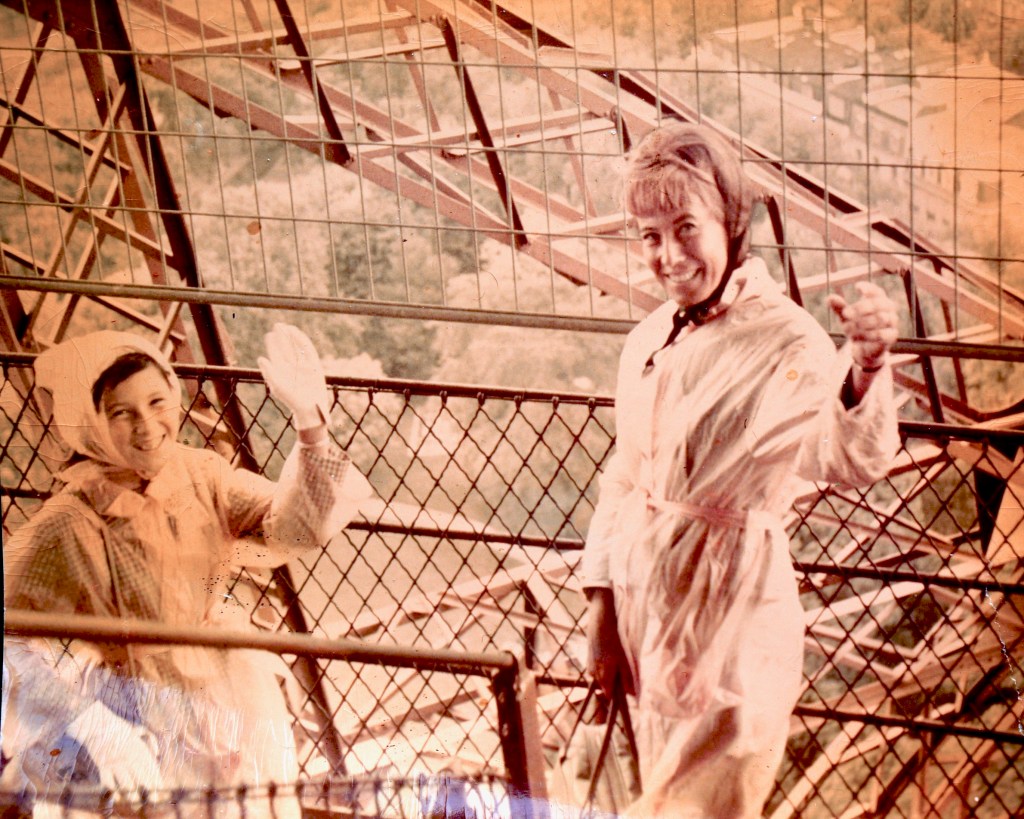
Sure, I was a little hot visiting the Acropolis, and we were pretty tired climbing to the top of Mt. Vesuvius in 1966 and looked forward to that Coke stand even with the fishy-tasing ice. But as we navigated forested Alpine roads, music festivals, museums, ancient ruins, French chateaus, and the Vatican, the sun was gentle and warm, and it often rained. I have a picture of myself as a child enchanted by the Eiffel Tower, waving at my dad in my pink plastic raincoat and little white gloves on the first day of September.
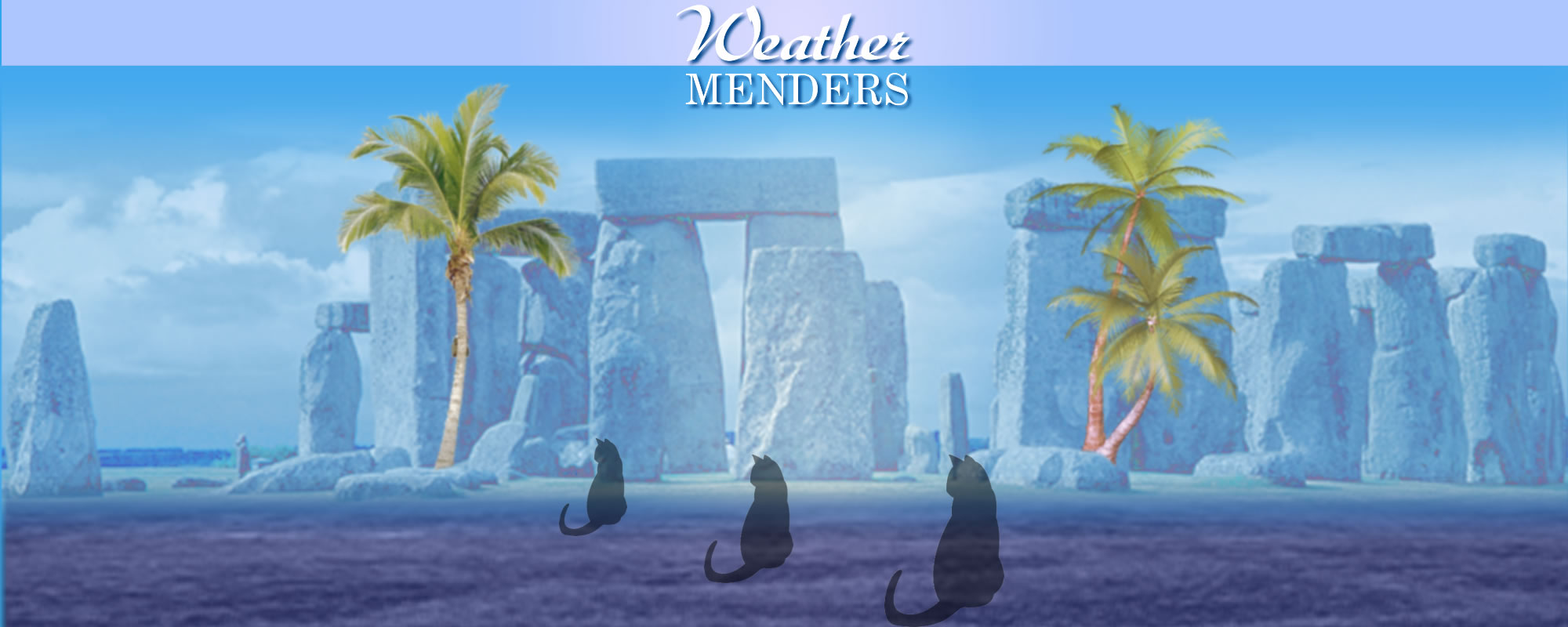
The achingly green land of Britain is withered and brown, just like New Mexico. Three-quarters of England, and all of Wales, is in drought, with worse water restrictions than we have here. In Weather Menders I imagined Stonehenge in 2050 as tropical, surrounded by palm trees and rice paddies, the risen seas having inundated much of the land. The population was greatly reduced by three pandemics (I wrote the book in 2015 and published it in 2017, way before COVID-19). I thought I was wildly exaggerating for the sake of drama.
It hurts my heart to see Stonehenge surrounded by brown withered grass. The last time I saw it, in a then-strangely-hot summer in 2013, it was the quintessential ancient “green and pleasant land” of the poet William Blake. Even as my friends and I sweated walking to Crop Circles, we breathed in the scent of the lush green land and the waving purple flax flowers.
And no one is going to be taking a European river boat cruise any time soon, not with the Rhine at 40 cm deep in some places. Nuclear power plants in Hungary and Romania have had to shut down most reactors because there is not enough normally cold river water in the Danube to keep it cool. Maybe rethink that plan for nuclear plants to power the voracious AI data center expansion.
Tens or even hundreds of millions of people must be experiencing solastalgia, even if they have never heard the word. I’ve heard teen-agers mourn their gentler childhood summers of a decade ago. No one has ever seen anything like this.
And yet…and yet I am not bereft of hope that we can stop the worst of the damage, mitigate, restore, even reverse a lot of the rapidly accelerating climate breakdown that has already occurred. In recent weeks I’ve read or watched commentary by climate activists like Bill McKibben, who points out the incredible progress made on more efficient and widespread adoption of what we used to call alternative energy technologies such as wind and solar, despite the fervent and irrational attempts of the current climate change-denying US regime to roll back all progress. McKibben’s TED talk states that “90% of new electricity generation worldwide last year came from sun and wind.” He calls it “energy from heaven, not from hell.”
Writer and climate activist Rebecca Solnit reminds us again and again that our situation, though admittedly dire, is far from hopeless. In her recent essay Cynicism and Naïevité in the Summer of a Thousand Fires, she writes, “…we do have a wide array of choices about how good or bad the future will be in how we act or fail to act. I think one stumbling block for a lot of people is the idea that if we cannot save everything, we cannot save anything, which is profoundly untrue and seems to arise from the habit of framing everything in all-or-nothing absolutes.”
George Monbiot writes about how positive and possible change can happen in a seemingly sudden tipping point. He reminds us that “despair is self-fulfilling; despair is disempowering; despair is what the bastards want you to feel. But above all, despair is irrational.” Complete climate breakdown, though we are in the beginning stages of it, is no more inevitable than death from a cancer diagnosis, even a dire one.
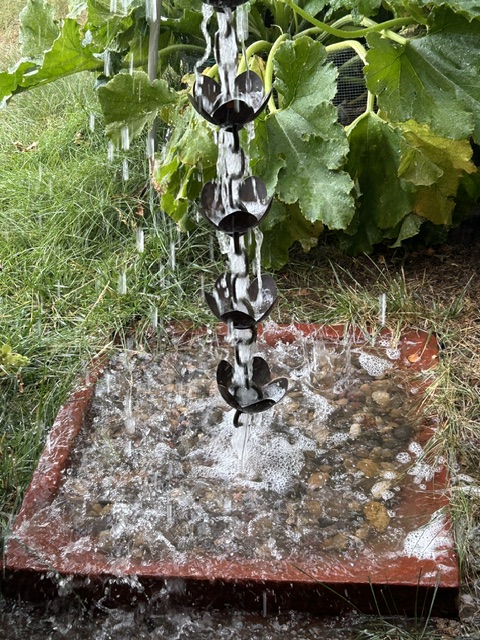
During our recent rainstorm I went outside and watched the water from my canales drain down my lotus rain chains into my underground water collection system. At first it dripped slowly, drop by drop, and then within about 9 seconds the drops suddenly joined into a flow state, a stream of water that got bigger and bigger until it was flooding the collection basins. I remember what Mother Teresa said to me when I interviewed her in Calcutta (now Kolkata) in 1979 and asked her if she ever got depressed: “Never!” she replied. “Little drops make the ocean. Our work is only a small drop in a very great ocean.”
My own paradoxical hope, inspired by these writers and others, rests on the concept of Black Swan events—highly improbable events that seem to come out of nowhere—coupled with action. The action can include political activism, planting a Climate Victory Garden, restoring soil, eating more carefully and consciously, and engaging in focused group or personal intentionality (sometimes colloquially known as prayer, visualization, or affirmations). For those inclined, here is the link to my 20-minute guided imagery Climate Healing Meditation.
Though some may say hope is not a strategy, I believe it is the only strategy—as long as it is the spark for action of body, mind, and heart. Hope can be the fuel for our righteous fury and our deepest aspirations to co-create a livable, even thriving future for the next generations of humans, non-human animal children, and the plant people whose land we share.
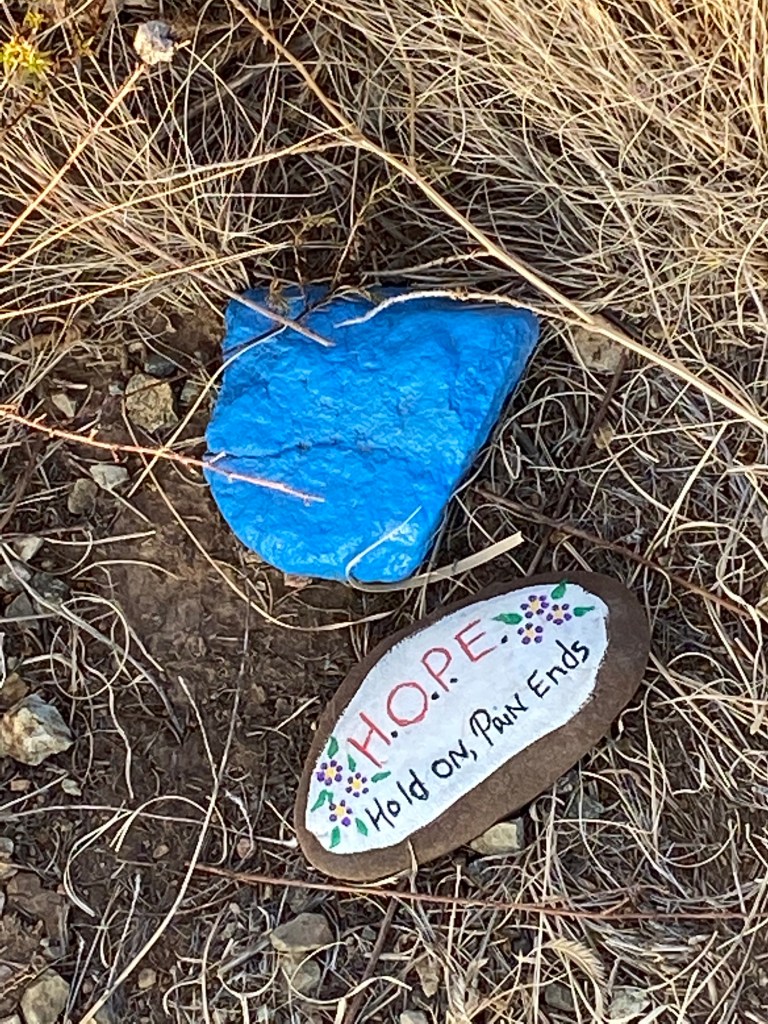
During the worst of the pandemic lockdowns, I came across small shrine-like art assemblies on the local trails in our semi-rural suburb. One of them lifted my heart at a time I most needed it, having just lost two friends, a long-married couple in London, to COVID. I later learned that an 11-year-old boy I never got to meet because the family moved out of the neighborhood before we were ever able to socialize, spent his days painting rocks and making community art for all of us. I cried when I saw his colorfully-painted rock that said: “H.O.P.E., Hold On, Pain Ends.”
Another exquisite writer on the climate crisis and the human connection with Nature is Willow Defebaugh, editor-in-chief and co-founder of Atmos. In a recent essay, she writes of the beauty of embracing paradox. More than one seemingly opposite experience can be true. On a daily basis so many previously unthinkable and horrific “impossibles” assault us and all life on Earth, from the constant violations of US and international law to the seemingly deliberate attempts to do the exact opposite of what we need to do to preserve thriving life. But the dismal future we appear to be moving towards at an ever-accelerating rate is not inevitable. I’m holding out for a swarm of multiple Black Swan events, the positive impossibles of our wildest imaginations. I’m opting for embracing paradox, as all good mystics and many quantum physicists do.
None of this had to happen, but at the same time all is not lost. To quote the author Arundhati Roy: “Another world is not only possible, she is on her way. On a quiet day, I can hear her breathing.”
Let’s use our own personal Earth Empathy in a good way, to go inside to our quiet places where we can hear the breath of the New Earth we seek to co-create.
Debra Denker is the author of Weather Menders, a cli-fi time travel novel for the hopeful.
Enjoy this inspiring and hopeful song, “Running,” sung by Sarah Brightman. “Green is shining through…””

 Weather Menders