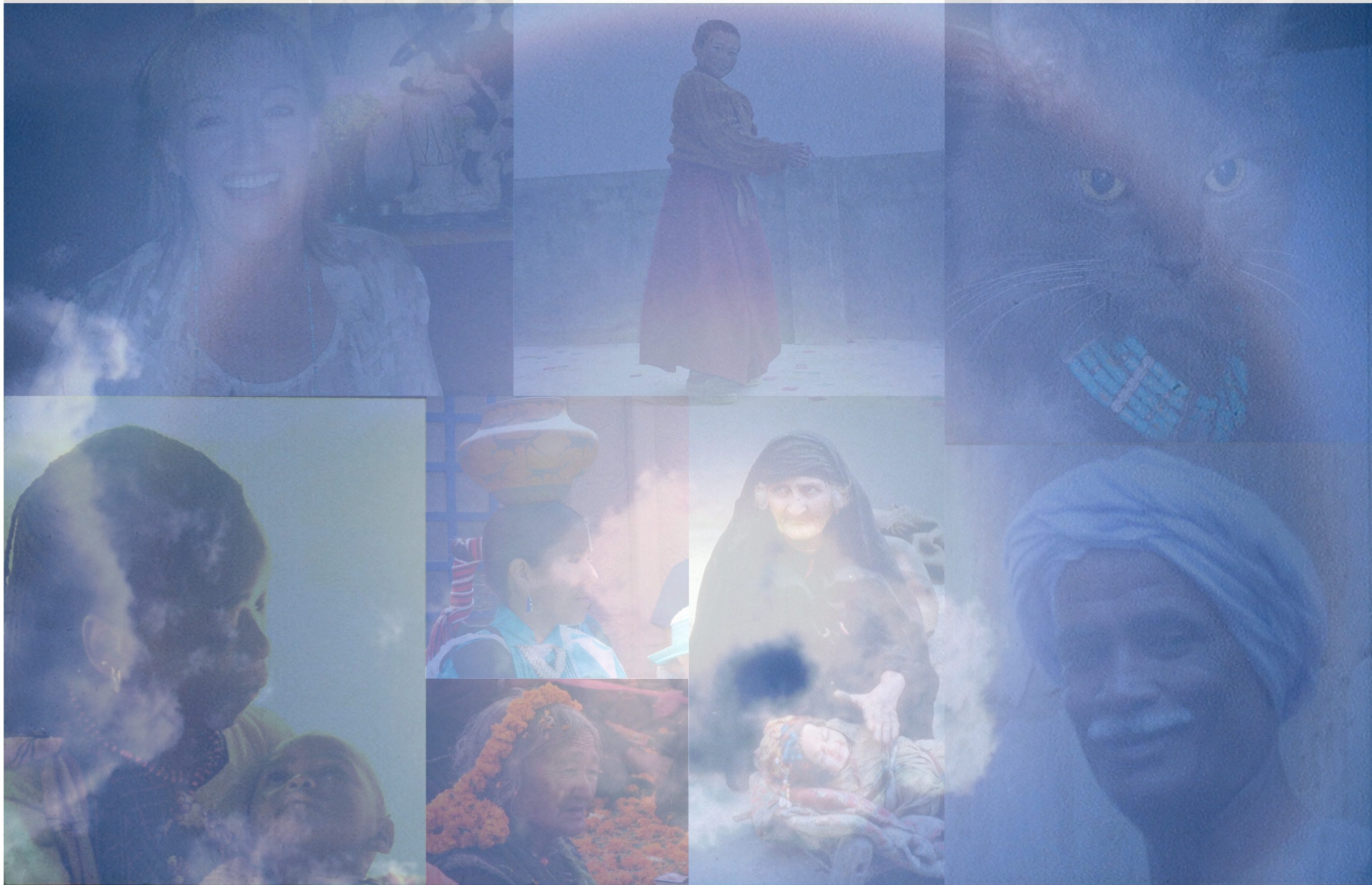
What if each of our souls has cycled through many incarnations over many millennia, in every part of the world, as every kind and color of race and appearance, as every gender—male and female, Two Spirit, non-binary? And that’s not even considering that our souls might come as other life forms, from cats to flies, dogs to snakes, horses to ants. Nor is it considering lifetimes on other planets and in other dimensions.
How does “belief” in reincarnation change a person’s perspectives, perceptions, and prejudices? Billions of people currently on Earth hold that belief, in one form or another. A 2025 Pew Charitable Trust survey found that a median of 33% of people in the 35 countries surveyed believe in reincarnation. But just like belief in any form of an afterlife, it’s a basic unprovable. Vivid past life memories, inexplicable instant connections and detailed descriptions by those who have returned from Near Death Experiences of tunnels of light, greetings from angels, and visions of long-passed loved ones may pique the curiosity of open-minded seekers, but are unlikely to convince skeptics.
More important than “belief,” what are the implications of reincarnation and karma, the law of cause and effect? Tibetan Buddhism, which I have studied and attempted to practice for decades, teaches that “we are all Mother Sentient Beings.” In that view, we have all been each other’s mothers at some time or other in millions of years of incarnations, on Earth and/or in other realms. Therefore, ideally, we treat every other sentient being, not limited to current humans, as our own mother.
This is relatively easy to imagine and project on beloved family members, friends, and animal companions. It’s more of a stretch with strangers, and can feel nearly impossible when considering harm-doers, especially those who engage in deliberate cruelty on individual or large scales. I’m not currently enlightened enough to see the mother sentient being in those who commit genocide, historically or in our current times, and those who collaborate, follow orders, and abet acts of horrific cruelty.
So I’ll leave aside that thorny question and simply focus on how we can see ourselves in other beings, starting with human beings.
For some of us who are born as empaths, this ability comes effortlessly, and in fact can’t be shut down even if we try. From early childhood we can’t bear the thought of killing an insect or a rodent, seeing harm and suffering come to a cat, a dog, or a wild animal, or hurting another child.
If you don’t believe in reincarnation, no problem. Whether you practice a religion that teaches that there is only one human life and then one afterlife or whether you are a secular humanist agnostic or atheist, empathy will get you to the same place as belief in reincarnation. Both believers and non-believers in reincarnation and karma can see themselves in the face of every human, and feel the joys and pains of all other forms of sentient beings as well.
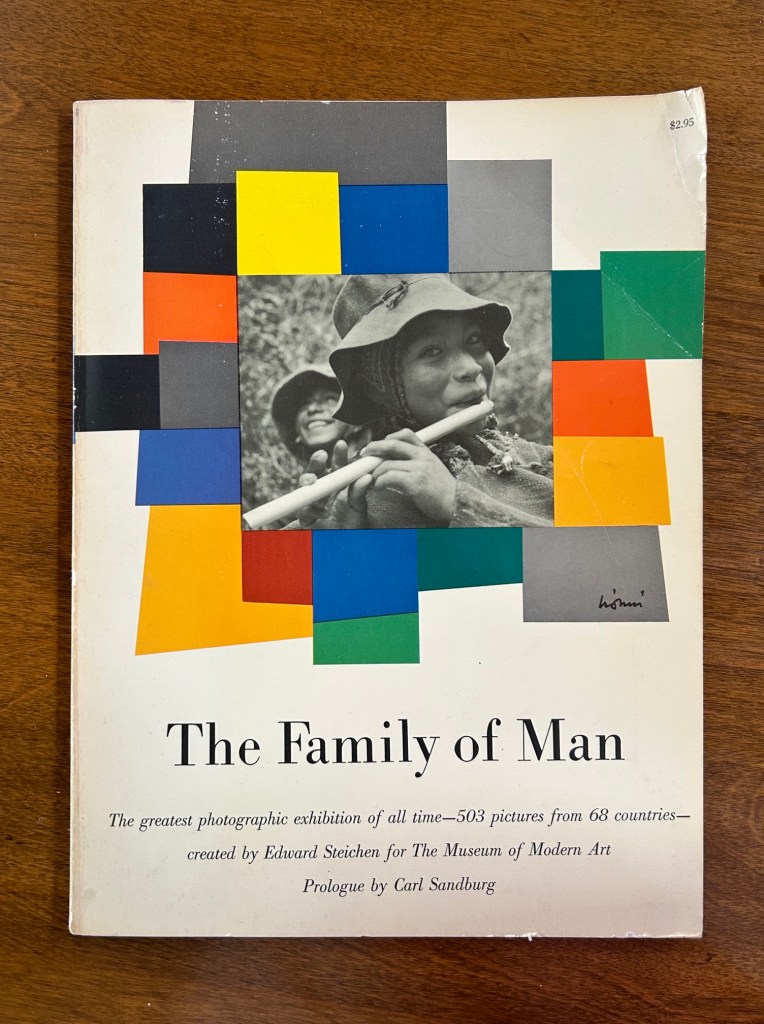
When I was in high school I received a book called The Family of Man as a Christmas present from a family friend who was like an older sister to me. The book is a compilation of photos from all over the world that were exhibited in New York’s Museum of Modern Art, and Lynn knew I would love it. The copyright date is 1955, but I received it in 1969 or 1970, after the famous Earthrise picture sent by astronauts back to Earth from moon orbit on Christmas Eve of 1968, and after the July 1969 moon landing.
It was the middle of the Cold War, but both of these events showed all of humanity a new perspective. Many credit the Earthrise photo with inspiring the first Earth Day, April 22nd, 1970, and the environmental movement that it catalyzed. Times were so heady and hopeful then, and it seemed not only possible but probable that humanity would work together to head off the threatened global warming that would occur a couple of centuries in the future (scientists thought then), feed everyone on the planet, and establish a rule of international law that would stop genocide and war.
As a high school student, I would pore over the photos in that book, as well as in Life magazine. My dad had taught me an appreciation and love of photography. He had been a photographer in his own high school days and soon after for the US Navy stateside during World War II. When I looked at the photos in The Family of Man, Life magazine, or National Geographic, it was so easy to feel myself as an African child, an older man or woman during the Depression in the US, someone joyously dancing in Italy, or a mother in India reaching out to her child.
It never occurred to me that not everyone possessed or even aspired to that same empathic ability, whether it was inborn or came from unconscious awareness of previous incarnations. The value of empathy was further reinforced in me by some of the more heart-centered nuns and priests of my childhood, and definitely by both of my parents. Somehow their shared expansive worldview, shaped by great poverty in childhood, transcended their respective homogeneous backgrounds of mostly white Christians and grew to embrace the entire family of humanity.
When Mother and I drove across what was then the Eastern Bloc and the Soviet Union in 1969, she simply said to me, “We’re not all that different. Everyone wants the same things: family, friends, a good life, good food, a decent home. Everybody just wants to be happy and have enough.” And further, “whatever government or system people are living under isn’t their fault.”
Especially in authoritarian and/or totalitarian nations. People in post-Stalinist Soviet Russia did not have much realistic opportunity for dissent. At the time we felt that the US was a democracy, albeit an imperfect one that needed more safeguards for civil rights—especially of nonwhite people and women—and human rights. Although I wasn’t a great fan of capitalism from the age of 15 onwards, I thought there was hope and that the US and other liberal democracies were at least moving in the right direction, though often in fits and starts and only as a result of pressure from an awakening populace.
Much later, in 1993, I had the experience of traveling in South Africa in the last year of apartheid with an African-American woman friend, Melissa. Although we knew the history of apartheid, we were naïve about how it permeated daily life, even in its dying days before the first free elections a year later in 1994 when Nelson Mandela would be elected president . Some of the cool New Age healers who had invited us to teach were, well, not quite as anti-racist as we had expected. Melissa chose to go home a few weeks early, breaking off from our teaching schedule to go meet the Zulu Sanusi sangoma Credo Mutwa and then heading back with palpable relief to her bicoastal life amongst artists in L.A. and New York.
I had teaching commitments, so I stayed on alone. One night a lovely white South African woman about my own age, 30-ish, was driving me to a healing class I was teaching. She turned to me earnestly and said that her meditation teacher, a white South African Hindu, said that “old souls got to be born in the white race and newer souls who had a lot to learn came first in Black and other races.”
I felt like I had been stunned by a physical blow to the head and heart. My heart raced and I wanted to spit out words of outrage and anger. Instead I took a couple of deep breaths, remembering that I was supposed to be the spiritual teacher.
“That’s not my experience,” I said quietly. “Or anything I’ve read anywhere or been taught by any religion. I believe we’ve all been every race, everywhere in the world, and will be again until we attain enlightenment. We’ve all been male and female. We’ve all had good lives of happiness and prosperity, and we’ve all died in wars. And we’ve all been soldiers and done terrible things, and hopefully have learned from those lives.”
I’d like to think that Vanessa took what I said to heart. She did go silent rather than arguing. But we lost touch, and apartheid ended as a system, and I will never know what and who she went on to be.
To this day I remain puzzled by people who can’t feel empathy—some of them quite famous and powerful politically and economically—whether the “feeling with” comes from belief in reincarnation and the resulting ability to identify with a full range of expressions of human and more-than-human animal life, or whether it’s innate. And I do believe empathy is innate, a natural part of being human, and for that matter more-than-human. Think of the loving empathy that your cat and dog companions show to you when you are ill or upset.

insisted that we knew each other in Ancient Egypt.
Those who cannot feel empathy, some of whom even devalue and sneer at it as a “weakness,” are a disturbing anomaly, perhaps even sociopathic. Rightwing Christian nationalists in the US have even called it a “sin,” a statement that I can’t even wrap my head around.
Lack of empathy is in a sense a failure of imagination. If you can’t see and feel yourself in the terrified eyes of a child ripped from their parent by a kidnapper disguised as a government agent, your own imagination has either utterly failed you or you have deliberately shut it off.
In January, in the wake of the murders of Alex Pretti and Renee Nicole Good in Minneapolis, I read similar thoughts in writer and climate activist Rebecca Solnit’s Meditations in an Emergency essay called “This Cold Winter, Love is a Superpower.” She points out that some individuals and subcultures are literally incapable of even conceiving that there are people—I daresay a majority—who will come to the defense of not only family and friends, but neighbors, community members, and even complete strangers, regardless of their race, religion, or national origin. Hard as it is for those of us who are empaths to believe that some people are incapable of “feeling with,” the wilfully non-empathic seem unable to conceive that many of us fervently aspire to altruistic values.
Solnit goes on to quote the British poet W.H. Auden’s review of The Return of the King, the final book in JRR Tolkien’s Lord of the Rings trilogy: “…Evil, defiantly chosen, can no longer imagine anything but itself. Sauron cannot imagine any motives except lust for domination and fear…”
Re-reading Solnit’s essay prompted me to dust off my falling-apart, yellowed childhood copy of The Return of the King and re-read the culminating scene. Recall, dear reader (or film-viewer) that Frodo’s ever-faithful companion Sam shows compassion, arguably born of empathy, to Gollum on Mt. Doom and doesn’t kill the creature when he easily could. Because of Sam’s act of compassion, Gollum is able to bite off Frodo’s finger, Ring and all, in Frodo’s moment of temptation, and fall with it into the volcano, thus saving Middle-Earth. At “the end of all things” Frodo remembers that Gandalf had said, “Even Gollum may have something yet to do.” Thus, at times, the hand of light seems to be moving the hand of darkness. Harm-doers can accidentally do something good and beneficial, regardless of their intentions and ego-attachment. I remain ever-hoping that some version of this will play out in our own current impasse.
Which brings me to the question: can imagination be awakened so that empathy can be taught and hatred unlearned? In the 1949 Rodgers and Hammerstein musical South Pacific, made into a movie in 1958, the song “You’ve Got to Be Carefully Taught” made a great impression on me when I saw it on TV as a child in the mid-60s. The lyrics that began “You’ve got to be taught to hate and fear” now seem way ahead of their time. Who, I wonder, taught the current crop of white supremacists and fascists, in the US and elsewhere, to hate anyone “unlike” themselves? Who taught them that skin color or facial appearance, accent, language, culture, or the way people pray make others “unlike?” And why would that be a problem? Why would the diversity of human expression lead to “othering?”
How do we reach those who believe that our differences are a threat instead of a joy? How do we teach empathy to those who hide behind masks? How do we look someone in the eye, hoping to make kind human contact, when they are intent on wrestling us to the ground, stomping on us, spraying us with painful substances—or even shooting us in cold blood without a second glance, or with cruel laughter and words of contempt?
For those who can be reached, we can only hold our own hearts open with all our might against the forces and events that would close them. We can only do our best to do what’s right in front of us each moment, to be kind even when it’s frightening, when we don’t know if kindness and empathy will be welcomed or mocked.
In the end, it’s a constant choice for each of us every minute of every day—ego vs. empathy, selfishness vs. altruism. Once you have known empathy, whether it comes from your own belief in reincarnation and that “we are all mothers,” or your innate ability to “feel with” others, it is impossible to shut it down. And this is what guides us to become the “possible human,” the ensan-e-kamal that the Sufis wrote of, the homo luminous that some visionaries speak of today.
Debra Denker is the author of Weather Menders, a cli-fi time travel novel for the hopeful.


