Today it FINALLY rained. We dare to hope that it’s the beginning of a proper monsoon season. Meanwhile it’s an incredible relief, and I feel gratitude as the land tentatively comes alive.

Some days it feels like I’ve spent 30 years praying for rain.
“Don’t be ridiculous,” I tell myself. “You’re exaggerating for the sake of drama.”
But recently I looked up the drought graph for the past 30 years in New Mexico and found out that I’m right. With the exception of a welcome blip here and there (June through December of 2006 comes to mind) we have been in drought for most of the time since I moved here 32 years ago.
I moved from L.A. to New Mexico to get away from heat. Now the joke is on me as day after day we have temperatures in the high 80s to 90s and L.A. has had temperatures in the mid-70s. On the upside, I did escape air pollution, noise, and traffic and have been privileged to live in a semi-rural area with dark skies, silence, and a variety of wildlife.
When I moved to my neighborhood outside Santa Fe the habitat was considered high chaparral pinon-juniper woodland. I grit my teeth when people who have been here far less time than I say, “well you moved to a desert.”
No, I most emphatically did NOT move to a desert. I respect desert ecosystems, but I never wanted to live in one. I loved the pinons until they all died in 2003 within a few months due to the pinon bark beetle, but really due to the ongoing drought and the relentlessly warming and drying trend caused by unchecked human-caused global heating. When the pinon at the end of my driveway began to turn the extremely pale green that preceded all the needles going brown I literally curled up in fetal position in the gravel at the end of my driveway wailing and sobbing.
At 7000 feet (2133 meters) Santa Fe used to be an oasis. No more. I look at photos of drought in previous years when the monsoons either were late or never quite got here, and at first glance it looks like the dead brown of the present moment, all the grass withered, almost no wildflowers. But when I zoom in close I see that even then, even in 2006 before the monsoons started, and in 2013, 2021, 2022, 2023 etc. the 40+ juniper trees that surround my passive solar adobe house were not turning brown due to extreme heat and drought stress, and trees all over Santa Fe were not dying.

No one has ever seen anything like this, not in living memory. People who grew up here, and people who have been here decades longer than I shake their heads and hide their tears. This is even worse than the 1950s drought, when they were down to 9 inches of rain a year and cattle were dying. The baseline temperature is much hotter than it was in the 50s, causing more evaporation and more water use. We try to live in denial. “Any day the rains will come. They’re just a bit late. It’s building up to the monsoon.”
Every day the forecast shows the possibility of rain. The sky clouds up, the wind comes up. And, like today, nothing happens. It must be raining somewhere, but not here. I look up to see the sun shining through a blue hole in the clouds. From the distance, on the highway on the way home, I can usually pick out the area around my house by that blue hole in the cloud cover.
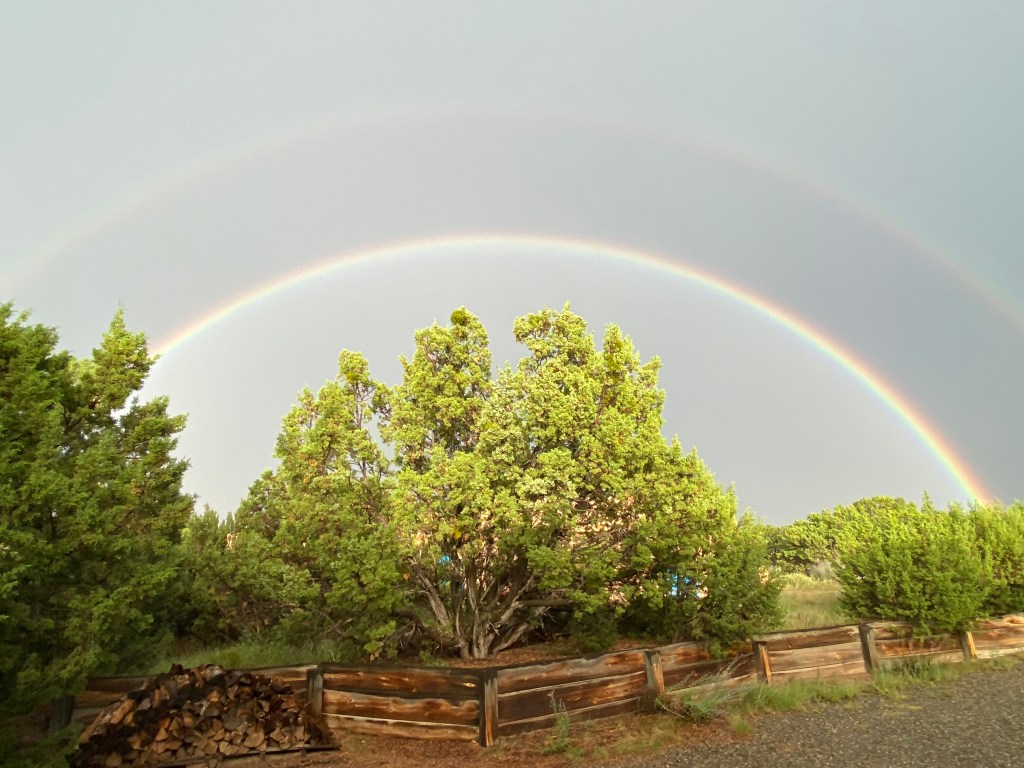
Due to shifting baseline syndrome, people who have moved here more recently than I blithely think that the new abnormal is normal. They don’t remember the almost daily afternoon rains all summer long from about solstice to autumn equinox. They don’t remember the huge storms, the roiling clouds, the life-giving deluges, the puddles in parking lots and driveways, the land coming back to life. And most of all the bright rainbows, often double and spanning the whole sky against a backdrop of charcoal-colored clouds and lapis skies.
They don’t remember the way the temperature would drop drastically and stay cool all night. The way we’d go to the opera or to jazz or blues or Native music on the Plaza and need a jacket or a shawl in the evening against the chill air. They don’t remember laughing in the rain and even being chilled to the bone on occasion and having to go home and sit in a hot bath—and not having the now yearly water restrictions that make one feel guilty for taking a hot bath.
I would never have voluntarily moved to our present climate.
But that probably applies to most of Earth right now. In July London has been about the same temperature as Santa Fe. So has most of Europe (or even hotter) and a lot of it is on fire. The US East Coast has cooled since the vicious heat dome of early July passed over, but they have humidity to contend with. I guess I’m supposed to be grateful for our sometimes below 10% humidity here, which in theory makes the heat more bearable but in practice sucks the moisture out of our skin and noses and organs and causes a different kind of irritability.
I have all the symptoms of Reverse Seasonal Affective Disorder, or Summer SAD, which is growing more common as the planet heats at exponential and unpredicted rates. There is no treatment. Even if I were open to taking SSRI antidepressants, the irony is that they make one more sensitive to heat. Full disclosure: I am more prone to heat sensitivity since I almost died of heatstroke while working as a journalist in Pakistan in 1982, a story I have told elsewhere.
So I “adapt,” resentfully. I never thought I would need air conditioning in those first years here. The temperature would plummet into the low 60s or even 50s as soon as it rained nearly every late afternoon. All we had to do was open windows and maybe turn on an overhead fan and the house stayed comfortable. My adobe house was degrees cooler than friends’ frame stucco houses, as I noticed when I would visit or go by to feed cats or dogs, but their homes were bearable too.
Around 2001 I felt I needed a portable swamp cooler in the bedroom to sleep well. Then a few years later a whole-house swamp cooler. Why not? I could afford it and the cool, moist breezes that one directed with slightly open windows were comforting and soothing. Those systems were even enough for Albuquerque, sitting 2000 feet lower and usually at least 10 degrees F hotter.
But then the fire smoke came, nearly every year. Swamp coolers, also known as evaporative coolers, work by pulling in outside air through filters moistened with water, which means one can smell and taste the fire smoke.
So I replaced the swamp cooler with a mini-split heat pump system, which is more efficient than conventional air conditioning systems. I’ve been able to invest in enough solar panels to produce more electricity than I use, even on these very hot days when I run the system in multiple rooms nearly 24/7. For me it’s a matter of physical and mental health, and certainly productivity. Like many if not most people, I can’t function well or think clearly in the heat.
I’m grateful for the AC, and even my cats gravitate to the cooler rooms or underneath one of the mini-split heads. I installed battery backup for my solar panels, but the surge that the mini-splits would cause in a power outage would reduce the battery time by so much that I was advised to keep that circuit off the backup. I dread to think what it would feel like in the house if we had a power outage, though I could run fans and even a portable swamp cooler. I wonder how my friends who have no cooling other than fans even survive, though most of them are more heat tolerant than I am.
But the drought is worse even than the heat that has gone on for weeks, with respite only in the early morning hours. It’s only 70 degrees F or under for about six hours these days instead of the 12 to 14 we used to get when we got regular summer rains.
This year my friend’s house outside Taos, about 100 miles from me and 1000 feet higher, is even drier than here. I spent a summer in Taos in 2018 and found my rental house oppressively hot because it didn’t have cross-ventilation to catch the breezes that came off the mountain every night after sunset. But it was a few degrees cooler than here—ironically, the year that I had just had mini-splits installed. My friend says the land around her is dead brown. The Taos Pueblo land visible from the main road, where bison often graze, is parched and dusty. Her land on the way to the Ski Valley has been overrun by prairie dogs who have eaten all the grass and any parts of her beautifully-landscaped garden that were not behind a wall. With record-low snowpack here as throughout the Western US and parts of Canada the centuries-old acequia irrigation network has provided virtually no irrigation water.
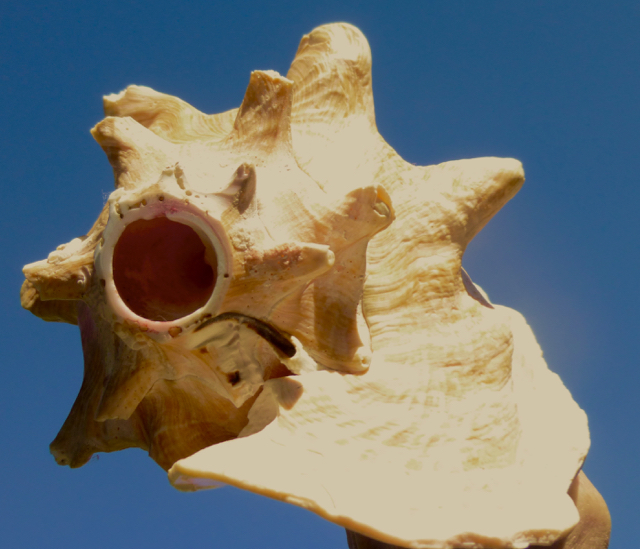
Those of us who believe in prayer pray for rain, each in our own way, and/or indulge in our superstitions. I washed my windows and paid for an expensive car wash as a rain sacrifice. I light yet another candle to St. Jude, patron of the impossible or lost causes. For 30 years I’ve been blowing a conch shell, shaking a rain stick, and praying the Tibetan Buddhist Mist of Great Blessings while shaking the rhythmic Daimaru hand drum back and forth. I make tobacco offerings in the juniper grove behind the house and beat the drum my late friend, Cree Medicine Woman Nicole Gladu, gave me on which I painted a rainbow Thunderbird.

And in previous years all this has “worked,” eventually. Of course many people were praying in many religions. And the Pueblo people were doing their Corn Dances. Or maybe we still had some grace left, and we weren’t in what might be runaway climate breakdown, and eventually the rains would come. And some years they would even be enough. The land was resilient then. The grass would green up overnight after a good rain and some years it would even grow, and wildflowers would bloom in profusion of yellow-gold and violet. And the trees would live, and the non-human animals thrive and give birth and raise their young.

I’ve seen coyote pups, young bobcats, badgers, and even deer on my critter cam this year, no doubt grateful for the fresh water I frequently refresh in the on-ground birdbath in front of the house. And I wonder where they go during this preternaturally hot days, and hope they have found or dug cool dens somewhere nearby. How are they surviving when everything is so dry? There does seem to be a counterintuitive profusion of rodents who wish to nest in my grill and garden bench, and desert wood rats (pack rats) who seem to build their middens ever closer to the house, perhaps because of the bird bath water source. So perhaps they provide sustenance for the predators—as long as we can keep our neighbors from using rodenticides that pest “control” companies talk them into with lying assurances that the poisons won’t get into the food chain.

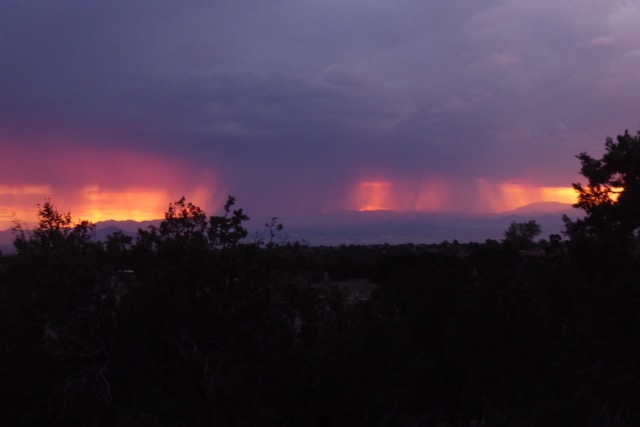
30 years of praying for rain, and sometimes the rains have come, the monsoon pattern to similar to the Indian Subcontinent where I spent so much time traveling in the early 80s. But more often than not the rains haven’t come in a timely manner, or they start promisingly and then peter out. Every day it clouds up and teases us and the clouds blow away. In the distance we see the dramatic curtains of virga rains, rains that evaporate before they reach the parched earth. Till today my rain gauge in my weather station showed 2.56 inches since January 1st. The Sahara gets about 4 inches a year.
The great drying is in process, I fear. We are in a megadrought, the worst for 1200 or so years. I understand why the Anasazi left what we now call Chaco Canyon, Puye, Bandelier. But this is by no means a natural variation. The brutal heat wave that hit Europe in June, and the strange heat wave that hovered over the Southwestern US in March, “spring,” when I was visiting Vancouver would literally be impossible without human-caused global heating, which seems to be uncomfortably and terrifyingly accelerating.
Tibetan Buddhism and many other spiritual traditions teach us to accept, to surrender, to let go. Maybe I need to accept that the climate here will never be the same in my lifetime, barring unforeseen deus ex machina interventions by angels, ETs, or my Weather Menders time travelers. I’m failing the “surrender” test right now. I’m often angry, because none of this had to be. It’s not like we didn’t know. It’s not like scientists and Indigenous prophecies around the world haven’t warned us for decades. It’s not like the collective didn’t have a choice.
A few days ago Megan Mayhew Bergman wrote in The Guardian about how we know how to mourn other humans but seem to lack rituals to express our grief for lost species, individual animals killed in wildfires and floods, and the ecosystem we have known all our lives.
I struggle to end on a note of hope. Because I must.
Each day I resume my rain prayers, hoping against hope that the supercharged El Nino that is doing so much damage by heating the planet even faster will follow previous patterns and at least bring rain to the thirsty Southwest. I’m visualizing that the rains come gently, that the parched land is softened first by gentle rains before the heavy “male rains” deluge the land. I am hoping my 5000 gallon underground cistern, which my mother and I had built in 2009 against such a time as this, will fill up since I have already used all the collected water deep watering the browning juniper trees and even some dying cholla cactus who barely flowered this year.
Tonight I can blow the conch shell and visualize more rain. I can sing the thank you song I was taught by my Lakota teachers, grateful for the sweet relief of the coolness of rain this afternoon, and hoping it continues and will bring the return of the green to nourish All Our Relations. Mee takuye oyasin.
Additional Resources:
I sometimes play the song “I Dreamed of Rain” by Jan Garrett and JD Martin on endless repeat. It used to work to bring rain and I hope it starts working again. It’s a really pretty song:
I also listen to a rain raga called “Rain Melody” from the Maharishi TM community.


