This may come as news to people in the eastern half of the US and Canada, and certainly to friends in Southcentral Alaska who just experienced their coldest winter on record, but here in Santa Fe, at an altitude of 7000 ft., we had no winter.
We had three measly little snowstorms, resulting in record-low snowpack, and a few days of cold here and there. The mountains, which I’ve never seen bare of snow before June 1st, were snowless at the beginning of April, briefly had a little from one storm, and then bare rock again at the end of April. The Rio Grande and reservoirs are at frighteningly low levels, and the historic acequia irrigation system on which many farmers rely is under unprecedented threat.
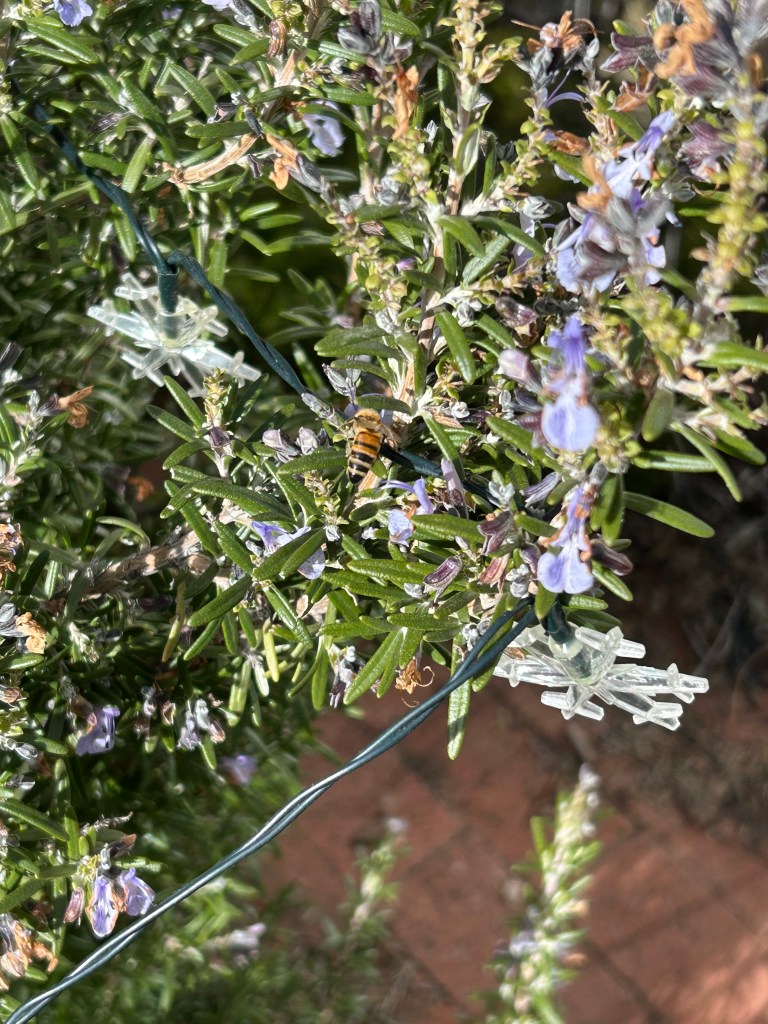
December Solstice to March Equinox was not winter as we know it, just the dormant season. Or perhaps the non-heat season, but even that is stretching it. On the balmy Christmas Eve of 2025, when the temperatures hovered around a southern California-like 70 degrees, the local honeybees sipped at the pale lavender flowers of my rosemary bush as a pink lemonade honeysuckle budded and I gently dismantled a pack rat midden at the base of the wisteria in my courtyard.
I managed to miss the anomalous summer-like heat wave in March, as I was visiting Vancouver, BC that month. As I read the news of the winter heat dome spreading over much of the US and told my house sitter to unplug the heat boiler, I decided I really didn’t mind the six-day atmospheric river lingering over the south coast of BC. Anything was preferable to drought and heat, especially so radically out of season.
But as I walked by the rushing Coquitlam River in the rain I noticed that the mountains above Vancouver had less snow in mid-March than they did last year in mid-May when I arrived to spend the summer. And now I read that due to drought Metro Vancouver has already instituted stage 2 watering restrictions. The once-lush and rainy area must let its lawns go brown, but that’s the least of the problems.
A greater worry, for much of the US and Canada, is wildfire danger. About 61% of the Lower 48 US is in moderate to exceptional drought right now, and the consequences can be seen and felt in the wildfires affecting Georgia and Florida. I actually thought I must be misreading headlines as I don’t ever recall major fires ever in that part of the country.
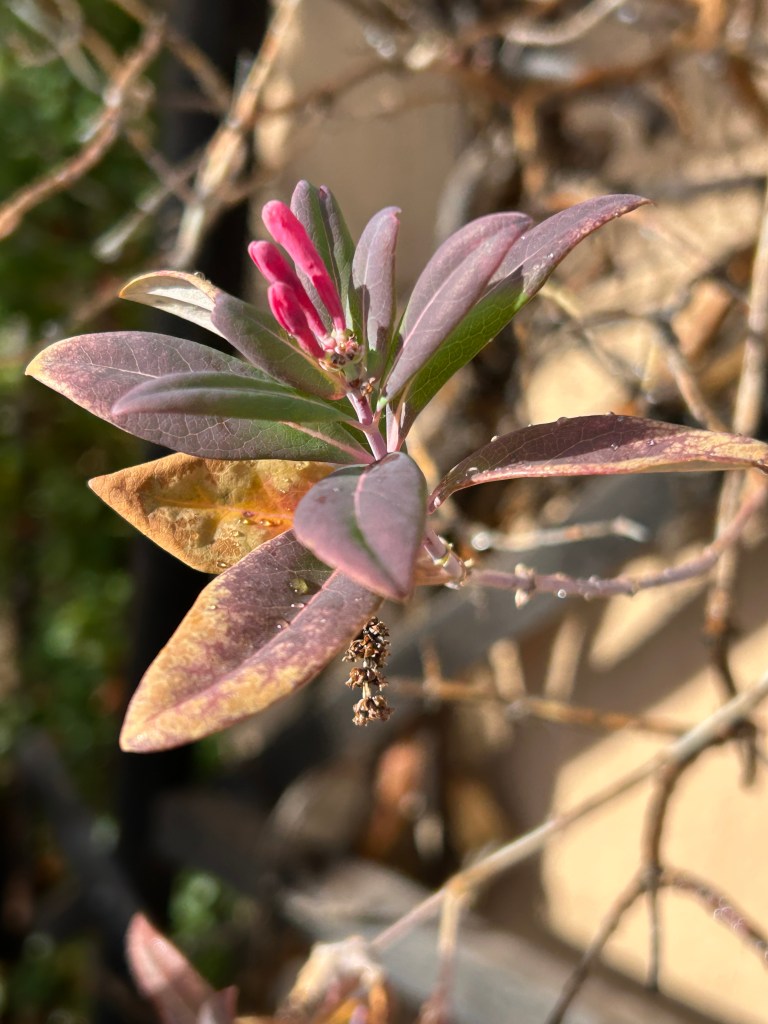
It’s hard not to be on tenterhooks here in New Mexico as we move through calendar spring in a state that may as well be called “sprummer.” The March heat wave—which scientists say would be literally impossible, not just unlikely but impossible, without the effects of human-caused climate disruption—caused many plants to flower four to six weeks earlier than the historical average. I tried to enjoy the scent of lilacs and the superbloom of the wisteria draping over the gate to my courtyard, but could not fully shake the cognitive dissonance of the timing mismatch.
Was I remembering wrong? Didn’t the lilacs used to barely start leafing out around April 20th at the beginning of this century? Didn’t lilacs and wisteria both reach full bloom around mid-May even less than a decade ago?
I looked at my record of garden pictures on my computer and saw that I was right. I guess with this drought, though oddly the map still shows Santa Fe County as being only in “moderate” drought, we should be grateful to have flowers at all.
And of course they all got frost-nipped. A few days after the month-early peak bloom the temperature dipped to 24 degrees just before sunrise. The wisteria and lilac blossoms shriveled overnight, though the plants themselves will survive. My apple tree, over 30 years old and the giver of the most delicious apples in the world according to many who have shared them and products made from them, had blossomed in late March, far before the first week of May that used to be normal. Perhaps I would have had at least a few apples, despite the lack of chill hours, but the buds of fruit forming on the pollinated flowers are dry and hard and look like they are all about to fall off. And some of the trees in town look odd as they leaf out, as bunches of dead brown remnants of autumn leaves cling to the ends of their branches, contrasting with the vivid spring green of the new leaves.
Last Friday The Riverside fire started in the bosque by the Rio Grande, near the center of the small town of Espanola. It could have been so much worse had the winds kicked up the way they did Sunday, howling at 50 mph and more. The fire was near homes and businesses, and Espanola Humane, one of the region’s most important no-kill animal shelters. Luckily they did not have to evacuate all the cats, dogs, and others from their new facility that serves the community with a needs-based spaying and neutering and trap-neuter-return, as well as the usual fostering and adoption. Fortunately no human lives were lost, and few structures. The fire was slow-moving enough that probably most wildlife was able to get ahead of it? But what of the small mammals like squirrels and pack rats? Were they able to outrun the flames?
For now we can breathe, but the worries and trauma from the big fires of 2022 are very much with us, depending on how close one was to the Hermits Peak/Calf Canyon merged megafire, and how one was affected. Many lost everything. Those of us farther away were lucky and were able to help with donations and other support. But everyone in the area was traumatized by towering pyro-cumulous clouds and the smell of smoke that makes all beings panic.
For six weeks the winds howled all day, and sometimes into the night. For six weeks I had go-bags in my car for me and for my two cats, and cat carriers in the kitchen in case I had to grab the cats and run. I shot video of the interior of my house and saved it into the cloud. I took a few family heirloom antiques, some favorite jewelry, and journals and archival slides from decades of travel in 53 countries to my storage unit in town. This not-a-morning person changed her schedule to get up early to offer Healing Touch treatments to a client on hospice in another part of town and then get errands done before the late morning winds kicked up. On extremely windy days I cancelled everything and stayed home with the cats, car keys by the door, computer bag next to the laptop.
Rain is predicted for later this week, on the eve of the Celtic festival of Beltane, which coincides with the full moon of Wesak this year, the celebration of the birth, death, and Enlightenment of the historical Buddha, Sakyamuni.
We hold our breaths, daring to hope but afraid to jinx it. I blow the conch shell to the Four Directions most nights at sunset. I make tobacco offerings in the grove of juniper behind my house, scattering shredded tobacco to the directions and praying the way that my late Cree Medicine Woman teacher and friend Nicole Gladu taught me to do. I honor the ancestors, the elements, the spirits and the more-than-human wildlife of this land, and pray to the Great Spirit for their and our safety from elemental and human harm.
Meteorologists say that a super El Nino may be forming. If it does, it might bring strong summer monsoon rains to the parched Southwest. It might bring winter snows at the turn of the year,at least at high altitude. With the unnatural warmth of the season formerly known as “winter” it’s more likely to be rain at our altitude at the base of the Sangre de Cristo Mountains.
And it might be “good” for our region, but it’s really, really bad for the planet as a whole, as it marks a whole new phase of likely record global heating and climate mayhem.
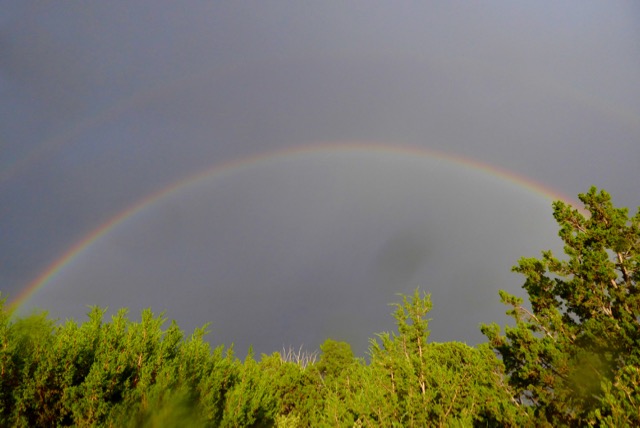
I didn’t move to a desert 32 years ago. I moved to an oasis, a high chaparral habitat of shrubs and in some areas pinon-juniper woodland. I left the heat and pollution of L.A. for the four beautiful seasons. I loved the gentler and wetter summers of Santa Fe with its daily downpours and double rainbows in the east as the golden sun set in the west, lighting up the raindrops on junipers, pinons, and wild blue grama grasses like gems.
I flinch when people call this a “high desert.” I cringe when people say, “well you moved to the desert.” I wince at my own naivety in thinking that the collective would surely make the needed changes soon enough to prevent the worst of the damage caused by global heating. With political and economic will, we can even reverse it in the coming decades by drawing down legacy carbon out of the atmosphere through Natural Climate Solutions, and Regenerative Agriculture and other practices.
A few years ago I saw a clip in a PBS retrospective of scientists speaking on the first Earth Day, April 22, 1970. They were concerned about the increased “greenhouse effect” of pollution in the atmosphere. It had to be stopped because if nothing was done to stop this accumulation future humans would begin to see serious planetary warming in about 200 years.
A little more than half a century later, here we are. Climate chaos surrounds us and determines our days, and our “plans,” such as they are. The predicted timing mismatches have arrived. For some reason the hummingbirds are late this year, and I worry that the lilacs and wisteria have already bloomed and their flowers shriveled in frost. Other plants have not yet flowered, since some plants flower in response to heat and others in response to lengthening light. I put out my homemade sugar water—the only thing I use commercial non-organic processed sugar for—in hopes of sustaining them as they arrive from their long journeys.
I saw a bumblebee in my courtyard where a mini-lilac bush that bloomed late enough not to get frost-nipped spreads it resplendent blooms and perfume. The bumblebee lifts my heart, not least because my late friend Nicole was deeply connected to the bees, especially bumblebees. Last summer in Vancouver, her granddaughter, now a young woman, and I repeatedly saw bumblebees in unusual places like the middle of urban areas. We smiled, feeling that Nicole was saying hello and reminding us of the ancient teachings she passed on to us.
The prophecies of the Cree and many other Indigenous peoples speak of some version of “three days of darkness” and no one quite knows what that means. Is it some unprecedented cosmic event? Or the failure of the internet, or even the whole electricity grid due to some Carrington Event-like super solar flare? Or is it a metaphor for the apparent darkness we are living through as the most lightless, cruel, religiously fanatical patriarchs of several nations and religions cause wars and much suffering of the innocent—humans, non-human animals, plant beings, and Gaia herself?
And yet I, like many others, see a light in the distance. I see a light of wisdom, a light of compassion, a light of balance, of returning hope. Earth will survive no matter what, it is true. But it is her inhabitants for whom I grieve, pray, and work—especially the humans of the Global South, and actually everyone who is not a greedy oligarch. They are the ones who have done the least to cause the problem but have suffered both worst and first from climate breakdown, along with all the non-human beings. What right did humans have to take over the great majority of the resources and space of this glorious planet and cause the extinction of so many species, and counting?
On my best days I see a subtle awakening in process. Like most change, it happens gradually and then all at once. As long as we are alive to breathe, love, feel hope and joy, then we still have the collective capacity to co-create a New Earth.
The words that Alfred, Lord Tennyson wrote in his poem Ulysses in 1833 echo with defiant hope through the Timeline of nearly two centuries:
“Come, my friends, ‘Tis not too late to seek a newer world.”
Debra Denker is the author of Weather Menders, a cli-fi time travel novel for the hopeful.


the same kinds of shifts happened here in Pine Mountain Club in Southern California. I loved the descriptions you used to describe the changes happening to where I am on the planet.
I’ll call you in the next few days.