I want to live on the alternate Timeline where Reagan was never elected president. Which, by the way, is central to the plot of my cli-fi novel Weather Menders. One of the main tasks of our Time Travelers—three from 2050, three from 2350, and one mysterious and wise gray time-traveling cat—is to ethically alter the past by thwarting the behind-the-scenes machinations that influenced the 1980 election.
What would our world be like today if President Carter had been re-elected instead of Reagan? Until January 2017 I considered Reagan the worst president in the history of the country. Indeed, the long dark shadow of 45 years of “Reaganomics”—also known as trickle down economics—has plagued our country and arguably the world with its legacy of increasingly extreme wealth inequality, tax cuts for the super wealthy paid for by cutting public services, the normalization of racism, and the decimation of education.

would like to wake up from his nap on another Timeline.
And let us not forget the foundational issue of the climate crisis, fast becoming an actual emergency. President Carter had installed solar panels on the White House roof to run a water-heating system. More importantly, Carter established the Solar Energy Research Institute (later renamed the National Renewable Energy Laboratory) way back in 1978. The Energy Tax Act that same year provided federal tax credits to homeowners for solar, wind, and geothermal systems as well as for energy conservation. The Solar Bank initiative was intended to provide federal subsidies to both homeowners and commercial solar projects. In 1979 Carter actually envisioned a “national solar strategy.”
Congress had allocated money for these programs, but they all went away as soon as Reagan came into power. Reagan’s removal of the solar panels on the White House in 1986 during roof repairs was the nail in the coffin of these early efforts at what we now call a Just Transition, and a clear signal of his ongoing love affair with fossil fuel companies. Even in the 80s, when many scientists (outside of Exxon, apparently) still thought that serious global heating was one to two centuries in the future, I knew this did not bode well.
I was a young journalist then, just starting out on my career writing first travel articles and then, after the December 1979 Soviet invasion of Afghanistan, op-eds and features on international affairs. In November 1980 I was working at my parents’ ad agency in Hollywood while preparing for my first National Geographic assignment. Devastated by Reagan’s victory, I wore all black, a black armband, and a silver peace sign the day after.
My parents weren’t any happier than I was, though they usually kept their views to themselves in public. But they didn’t stop me from making my own views known, which in retrospect I deeply appreciate.
Little did we know then that Republican campaign operatives had been secretly meeting with representatives of the Iranian revolutionaries holding American embassy employees hostage in order to thwart President Carter’s impending deal with Iranian President Bani Sadr to release the hostages. There would be inconclusive Congressional investigations in 1992-93, and much later a 2024 book by journalist Craig Unger that presents convincing evidence, Den of Spies: Reagan, Carter, and the Secret History of the Treason That Stole the White House. When I started writing Weather Menders in 2015 my research led me to believe that the October Surprise theory was plausible enough to include it in my plot.
I went on to build my career as a journalist, writing twice for National Geographic, my childhood dream. My June 1985 cover story on Afghanistan, illustrated by Steve McCurry’s iconic photo of the Afghan girl with haunted and haunting green eyes, gave me a certain cachet for a few years. I was sought out as a speaker and interviewed in many media outlets. I parlayed this into an entrée to major publications where I could express my opinions on a number of subjects, all of which I considered interrelated.
In 1986 I had an op-ed scheduled for publication in the New York Times called “Reaganism: An Extreme Form of Brahminism” (referring to the outlawed caste system of India). The day before it was to be published the Iran-Contra story broke, and it was bumped.
Not getting published in the New York Times probably made no difference to the arc of my life and various careers, whereas the knowledge of the corrupt and scandalous Iran-Contra deal reverberated for years.
But when I came across the op-ed a few months ago in a drawer, I found it chillingly prescient. That’s the problem when psychics write op-eds—and fiction for that matter. So much of what I wrote in Weather Menders is coming true, from good parts like a gray cat appearing out of a blizzard outside my semi-rural house on Christmas Eve of 2016 to bad parts like the breathtakingly rapid climate change occurring in Britain and elsewhere, and the tragic Taliban takeover of Afghanistan in 2021.
So what would our current Timeline be like if Reagan (and his rightwing cohort Prime Minister Margaret Thatcher of Britain) had never come to power? Would there be greater wealth equity and social equality? Would we be free from oligarchy and corporate control? Would the US have universal health care? Would we have stayed out of various wars, if they had happened at all? Would we have a healthy appreciation of diversity in every way? Would the UN have been strengthened and respected and would this have brought about greater peace and international cooperation? Would racism and sexism be historical curiosities to be studied as cautionary tales?
And at the foundation, would humans have come together to stop climate change in its tracks before it became the existential crisis, twinned with biodiversity loss, that it is today?
Let’s take a look at the op-ed I wrote 40 years ago that came so close to being published (in blue) along with my current commentary (in red). If only we could have avoided 45 years of failed trickle down economics that supported the growth of oligarchy worldwide while impoverishing most of humanity and leading towards rightwing populist movements that threaten democracy and freedom worldwide.
Then after our historical review, let’s imagine some solutions, a way forward for humanity and all beings on Earth.
Reaganism: An Extreme Form of Brahminism
(The Hindu Caste System was outlawed by India’s 1950 Constitution, but caste discrimination is still practiced by many in India and in the diaspora, including in the US).
The Reagan Administration is turning American into a Third World country. An extreme statement, perhaps, but let’s take a look at the evidence. What factors constitute a Third World country, in the popular imagination, if not in the statistics books of economists? Unemployment, lack of education, illiteracy, hunger, inadequate shelter, lack of access to amenities such as cars, telephones, electricity, natural gas?
(We would not use the term “Third World” anymore. “Developing nations” or “global South” would be more correct and contemporary.)
Now let’s look at America in the 80’s, post-Reagan-budget-cuts. Unemployment, once 11%, is now down to an “acceptable” level of 8%; the Bureau of the Census has reported that 15% of Americans were living below poverty level in 1982; a report in the Los Angeles Times in spring, 1982, stated that an estimated two million Americans are homeless, living in shacks beneath bridges, in cars, or on the streets. The homeless and poor are presumably hungry, despite blithe statements by presidential advisors who should know better, that there really isn’t any hunger in America, and after all, black children are the best fed in the country.
(Good Lord, did they really say that?! Though unemployment rates are measured as 4.2% as of September 2026, we certainly continue to have a significant number of unhoused people, and many others falling through the statistical cracks because they live in cars or temporarily with family members or friends, and with growing food insecurity due to inflation—and hello, climate change reducing harvests, and oh, draconian and cruel immigration roundups leaving food in the fields unpicked).
Many Americans retain their homes, but have their utilities turned off for non-payment of bills. Every winter we hear of elderly citizens freezing to death after their heating has been cut off. Many states, but not all, do ban disconnection of fuel service during winter. But in the winter of 1982-83, the ten largest electrical and gas utilities cut of 41,000 customers in those states that do not ban winter disconnection.
(Consider that monopoly utilities are being targeted for acquisition by private equity companies beholden to no one but shareholders, and certainly lightly regulated. Utility costs are currently rising due to the voracious appetite of AI data centers for electricity and water coupled with the US regime’s focus on making renewables less accessible while promoting the use of polluting and planet-heating fossil fuels).
The decline of education has been lamented for the past two decades. We are producing semi-literate high school graduates who cannot fill out a job application, balance a budget, or calculate a grocery bill. A friend who taught Freshman Composition at an exclusive private university in southern California was dismayed by the fact that many of her students could not write proper sentences, let alone string them together into a coherent composition.
(Don’t get me started on the decimation through underfunding of education in this country since the Reagan regime. Some think that this was deliberate in order to create a semi-literate populace to be corporate cannon fodder, and low information voters subject to manipulation by legacy media and now “social” media).
But for all of this, America is still a rich and prosperous country. The majority of us, though we have had to cut back on purchases, plans, and even food, still enjoy a standard of living far higher than that of all but an infinitesimal minority of the Third World.
The frightening thing is that it is no longer accepted as given and possible that the same benefits should be extended to all sectors of our society, and to all nations of the world. As we have come to realize that resources are limited, there has grown a terrifying tendency to scrape up all that one can of these limited commodities, rather than sharing what there is, or better still, exploring alternative sources.
(Somehow the zeitgeist of the 80s became “greed is good,” which flies in the face of moral teachings of all spiritual traditions and secular humanism. I’m still trying to figure out how this happened, how the proportion of people in the middle class shrank while the left-behind white working class was pitted against, well, everyone else—immigrants, people of color, women, people of different religions, or just different in any way. Instead of seeing that corporate monopolies and the upward flow and concentration of wealth amongst oligarchs is the cause of so much of our misery, too many of us have given in to the false fantasies of the division agenda. If only we still had powerful labor unions…oh, that’s right, Reagan began the destruction of unions when he broke the air traffic controllers strike and decertified their PATCO union in 1981).
Over the past few years, as the economic situation in America has worsened, I have spent a great deal of time in Pakistan and India. I have seen poverty of the type most Americans cannot imagine. Thousands of people in cities like Bombay (Mumbai) and Calcutta (Kolkata) are born, live, copulate, give birth, and finally die on the streets. “Beg for profit” gangs still kidnap village children and mutilate them so they can beg and give their takings to the ringleaders.
There is a fatalism in India that most Americans might find curious, but also somehow familiar. The caste system has been officially banned in India, but still exists in the collective mind. Formerly, an orthodox Brahmin, a member of the highest, priestly caste of Hindu society, believed that he or she was born a Brahmin as a result of meritorious deeds in past lives. Untouchables (now referred to as Dalit) were believed to have been born to their lot as a punishment. As long as that philosophy was accepted by all castes and classes, Indian society was static. Today, this religiously institutionalized stratification is no longer accepted as a given, and official efforts are being made, via a quota system, to give chances at education and jobs to former outcastes.
America, by contrast, has always been a more mobile society. It used to be possible, in one generation, for a child of parents with sixth grade educations who worked as poor farmers or laborers during the Great Depression, to become a successful executive or owner of a small business. The children of this child were sure to get a college education, only to find out that a college education did not necessarily guarantee a job.
(Well, social mobility was a lot more likely if the child was from a white family. While affirmative action helped, and some people, like my dad, were hiring for diversity back in the late 70s in the name of fairness, people of color faced far more systemic barriers than white people).
American society has not become immobile. We may hope that the current slump is indeed, as the economists tell us, a passing phase. But there is a curious attitude emanating from our elected leaders, a strange fatalism that implies that if one is born poor, it’s one’s own damn fault. There is a tendency to discriminate between the “deserving poor” and the “undeserving poor,” the “truly needy” and the, what, “untruly needy?”
The criteria by which we are judged remain mysterious and arbitrary. A woman severely disabled by a back problem, able to stand for only two or three hours, is suddenly cut from disability rolls. The government doctor claims she can work for eight hours a day. She may appeal, but meanwhile, she has lost her benefits, and wonders how she and her unemployed husband will live.
(This has gotten a lot worse. The US is the only developed nation where medical bankruptcy is not only possible, but fairly common. The deliberately cruel and draconian cuts to social programs in the US by the current regime beginning in early 2025 have decimated, or will over time decimate, everything from food security to Medicaid to public news sources like NPR and PBS. Real-world inflation, especially of groceries, can literally take a shopper’s breath away, though some of this is due to climate breakdown and the rest to the capricious, unpredictable, harmful tariffs on so many items, to the dizzying cost of fuel, especially diesel, due to the war of choice on Iran, and to sheer corporate greed).
It is the lack of compassion shown by our leaders that is so distressing. (my emphasis) A society will ultimately be judged by the concern that it shows for its weakest (I’d now prefer “most vulnerable”) members. What was a given a mere ten years ago, that we should care for the poor, the elderly, and people with disabilities or mental illness, has instead turned into an implicit and cruel repudiation of the weaker sections (most vulnerable members) of society, a laying of the blame on their own doorsteps (if they still have a doorstep).
The Reagan Administration, with its huge defense expenditures over-balancing social spending, much as in many military-obsessed Third World countries, has justified selfishness as a way of life (my emphasis). It is no wonder that hardline “touch my can of corned beef and I’ll blow your head off” survivalist groups flourish in this inhospitable climate. Those of us who do not believe in the virtue of selfishness (the title of Libertarian idol Ayn Rand’s book) can only hope that the political parties will provide some passionate and dynamic alternatives in 1984, and that the American people will have the good sense to choose them.
Well, it didn’t happen. The above was to have been published in November 1986 and that line would have been rewritten. In November 1984 I was in a refugee camp in Pakistani Baluchistan, working on my National Geographic story, when my Pakistani government liaison informed me that Reagan had been re-elected. I doubled over in emotional pain, sobbing, and almost collapsed to the ground, stunned, knowing what was coming.
I see a direct line from the casual cruelty and racist dog whistles of the Reagan era to <Project 2025> and the horror that the US, and by extension the whole world and all life on the planet, are living through right now.
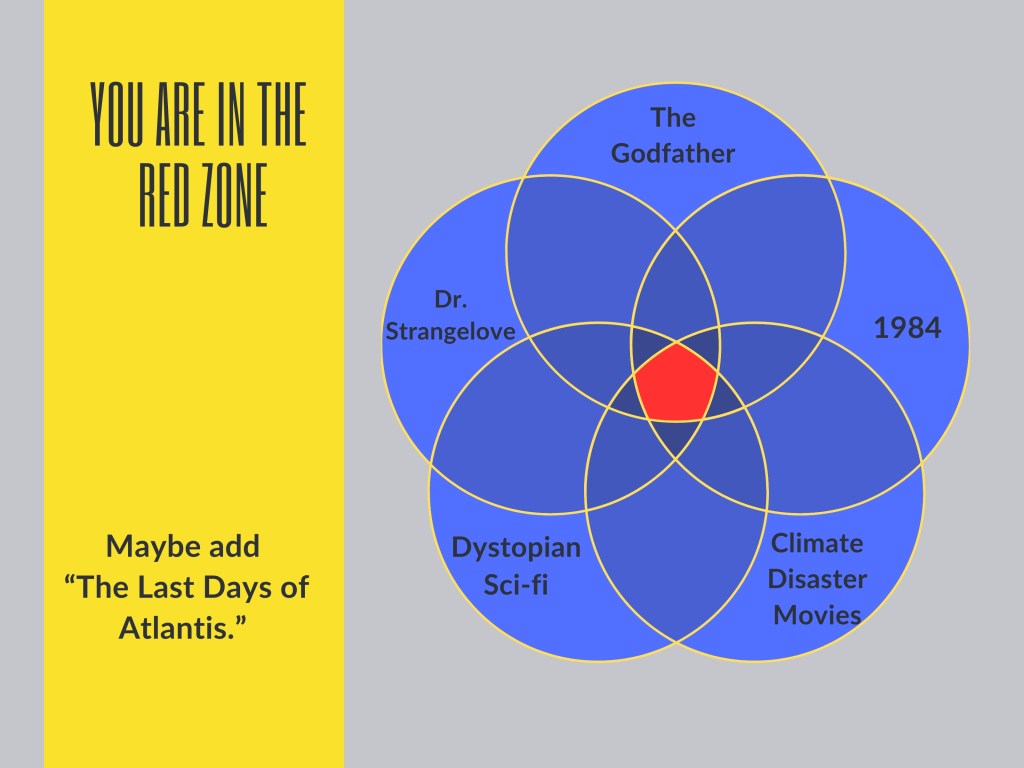
I don’t like this Timeline! I want to live on the alternate Timeline where humans of goodwill, which is surely the majority of us, all came together years ago. All nations, all races, cultures, and genders, are working together to head off the climate and biodiversity loss crises, and by now have largely succeeded. Because women and girls had access to good educations, reproductive choice was increased, and the world population—now supposedly 8 billion-ish but possibly more according to recent studies—stabilized at maybe 5 or 6 billion. Guided by principles of sustainable growth and fair distribution worldwide rather than fantasies of endless and unrestrained growth-for-growth’s sake, we are living within Earth’s comfortable carrying capacity.
We are already living in a circular, or doughnut, economy. The air is pristine due to the use of affordable renewable energies not even thought of or created on the icky Timeline, and the climate is the same stable climate that allowed the development of human civilization for the last 11,700 years or so of the Holocene. Humans live in harmony with Nature, seeing themselves as a part of Nature rather than separate and dominant. Regenerative agriculture practices constantly renew the soil, and fresh organic food is available to all at a reasonable cost. Kindness and concern for others—in other words altruism for humans, non-human animals, and all sentient beings—is our guiding principle.
And soon we connect with our Star Siblings in this galaxy and beyond, with interdimensional beings of wisdom, and even Time Travelers. Or maybe they are all the same.
That’s the Timeline I want to live on, one where our collective imagination did not fail, but has triumphed.
Maybe the Weather Menders Time Travelers succeeded after all.
Further reading and thought:
To be fair, Reagan did negotiate nuclear arms control treaties with the Soviet Union. Although he ignored the June 12, 1982 anti-nuclear demonstration of one million people in Central Park (I was there!), he apparently had a change of heart after watching the chilling 1983 film The Day After.
In addition, he signed the 1986 Immigration Reform and Control Act into law, which gave amnesty to 2.9 million undocumented immigrants.
He also told Israeli Prime Minister Menachem Begin to stop bombing Lebanon. Within 20 minutes the bombing stopped.
So I’m willing to admit that President Reagan did have some redeeming qualities, even though I’d still rather be on the Timeline where he was never elected.
People with far more experience and fame than I have analyzed this history in detail. Thom Hartmann has frequently mentioned the Republican plot to undermine President Carter’s re-election in The Hartmann Report, and has written a book called The Hidden History of Neoliberalism: How Reaganism Gutted America. As Hartmann points out repeatedly: “Two-thirds of us were in the middle class when Reagan came into office, and could get there with a single paycheck thanks to FDR‘s and LBJ‘s ‘socialist’ New Deal and Great Society policies. Today it’s only roughly 45% of us, and requires two paychecks. All because of 45 years of Reaganomics.”
Hartmann has also written about the damage that “share buybacks” have done to the US economy and to the personal economy of the great majority of the people of the US and the whole world. In his 2022 article “The ‘Share Buyback’ Looting of American Business” he explains how “share buybacks,” the practice of corporations deliberately manipulating stock values through buying a certain number of their own shares—rather than putting profits back into growing the business and paying workers higher wages—and thus decreasing the number of shares on the market, were illegal from the creation of the Securities Exchange Commission in 1934 until, you guessed it, Reagan legalized the practice in 1982 through Rule 10b-18. I never understood the concept as I found it so illogical from the standpoint of the common good, but Hartmann explains well how it has benefited the already-wealthy and deliberately increased wealth inequality.
I also appreciate the perspectives of former Secretary of Labor Robert Reich, historian Heather Cox Richardson, and feminist climate activist Rebecca Solnit, whose Meditations in an Emergency can be found on Ghost.
What is the way forward?
Pretty much the opposite of all of the policies of the current US regime. For starters, let’s go back to the 70% maximum tax rate before Reagan’s tax cuts for the wealthy. That could fund universal health care, a just transition to the Green New Deal, support for education, research and advances in science and medicine, environmental clean-up, etc.
In the alternate Timeline we don’t have large numbers of desperate refugees fleeing climate disasters and attendant wars, but in the current Timeline we need to have immigration policies that reflect those realities, and are based on compassion. Why not do what Spain has done recently and create an amnesty for law-abiding immigrants even if they arrived in whichever country without following procedure?
And let’s not only renew the 1987 Intermediate-Range Nuclear Forces Treaty— which Reagan negotiated with Gorbachev and the then-Soviet Union—that was just allowed to expire, but let’s go further and ban nuclear weapons worldwide.

With the power of imagination, a better world is truly possible.
Debra Denker is the author of Weather Menders, a cli-fi time travel novel for the hopeful.


