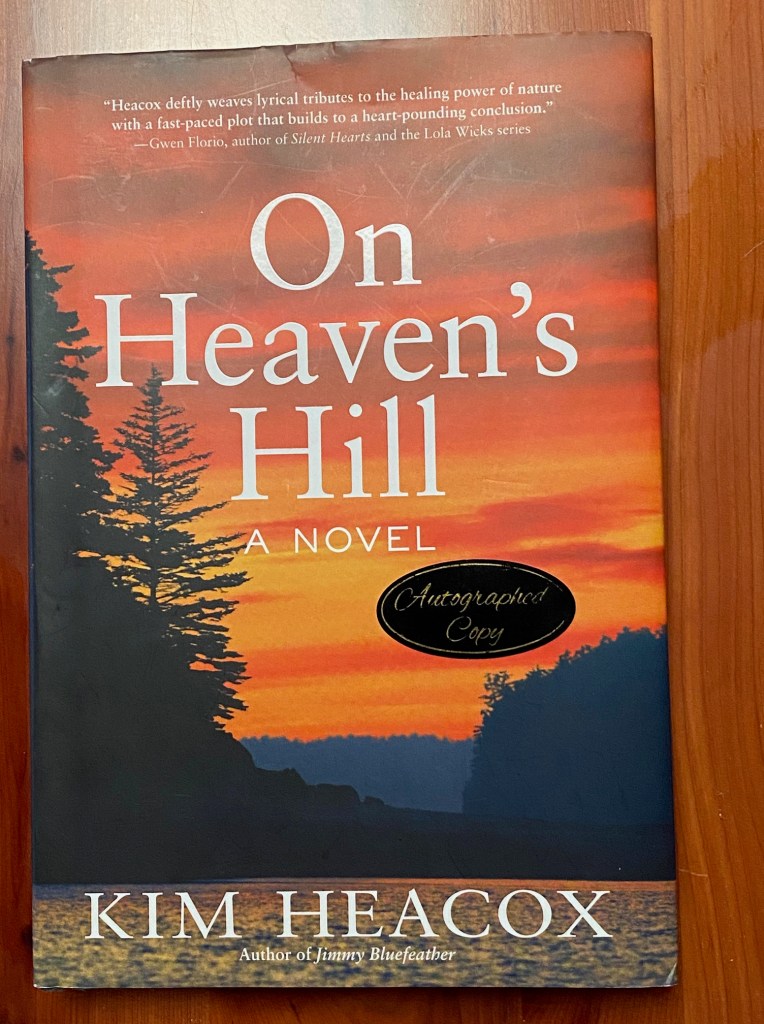
Kim Heacox’s latest novel On Heaven’s Hill is a vividly written tale of healing and redemption through connection with nature in the wild rainforest of Southeast Alaska. It is a multi-layered story with complex and sympathetic characters—one of them a wolf, the courageous and clever young male Silver. Magic weaves itself throughout the narrative and several subplots about community and compassion.
I picked up On Heaven’s Hill at Mosquito Books, the Anchorage Airport bookstore where I always buy a bottle of water for my flight and often buy a book. I discovered Heacox’ first novel Jimmy Bluefeather there a few years ago and was enchanted by his fluid writing and his evocation of spirit of place. I found On Heaven’s Hill just as engaging. By the time I landed in Seattle I had read the first hundred pages, looking up only occasionally to gaze out the window at the clouds.
Although the book is not a cli-fi novel per se, climate breakdown looms as a constant underlying threat, a warp thread to the richly-textured weave of the story. The three main characters through whose eyes the story is told and a host of finely-drawn minor characters all face their personal confusions and choices in a strangely changing and unsettled world.
Silver the wolf and his pack are unaware of the human concerns that impact their way of life and threaten to steal their very lives. He is a smart and particularly observant young wolf who has to grow up fast as humans threaten his family’s habitat, way of life, and safety. These wolves in the wilds around the mythical Menzies River catch and eat salmon, an unusual dietary adaptation that becomes pivotal to the fight of sympathetic humans to protect both wolves and wildness.
Kes (short for Kestrel) is a 12-year-old girl searching for answers to existential questions. Her beloved dad Danny, a country singer of note, has been grievously wounded in body and mind while serving in the Texas National Guard in Afghanistan. As he learns to walk on prosthetic legs, the greater challenge is regaining his voice. Kes wonders whether her dad will ever speak again, let alone raise his voice in song.
Kes’ pilot-geologist Uncle Ty, her dad’s brother, is a one-man Greek chorus teaching Kes and the reader about all the interwoven ills of modern life—separation from Nature, the bitter uselessness of war, greed, capitalism, colonialism, climate breakdown, and all manner of injustice. Kes proves a willing and self-motivated student when Uncle Ty invites her, her dad, and her stepmom Rita to move from Texas to Alaska where Danny can pursue his journey of healing surrounded by other veterans in a makeshift settlement called Willynillyville on the outskirts of the town of Strawberry Flats, near the Crystal Bay Marine Reserve.
Uncle Ty flies the family up to Alaska in his Cessna, a magical journey for Kes that expands her world as she sees the vast landscapes of North America unfurl beneath them. Rita is at first appalled by the rustic conditions of Willynillyville, Danny silent and watching rather like a wolf, and Kes consumed by hope and open to learning about their new home as she thrills to the harmonic howls of wolves in the distance.
Their lives will intersect with diverse people, from vets with PTSD to Alaska Natives to Evangelical Christians. The third character through whose eyes the story is told is a former wolf-trapper, Salt, a devout Christian struggling to come to terms with the serious illness of one of his four sons, the good-natured and funny Solomon, and the increasing internet radicalization of his eldest son Abraham. In Salt, Heacox has created a complex and sympathetic character. Salt constantly quotes the Bible but never becomes a cliché or caricature. Salt is not a rightwing climate change denier, and his time in the Alaskan Bush has taught him to find God in Nature. He is a man of faith who is not afraid to question, and who aspires to be the best, most moral man he can be.
Salt and his wife Hannah struggle to give Solomon the best life and medical care possible. Unfortunately, as all Americans know, the best care is often not affordable. When shady characters connected vaguely to a rightwing governor and to mysterious corporate interests approach Salt offering large under-the-table cash payments to do a little wolf reconnaissance, he must face his temptation and make difficult choices.
Meanwhile, Kes is drinking in knowledge, guided by her Uncle Ty, a former petroleum specialist in Iraq who “rose to the rank of major and came home convinced war is madness.” Kes reads books like Brave New World and Rachel Carson’s Silent Spring. She is particularly affected by Sand County Almanac in which Aldo Leopold recounts his own conversion to ecology after seeing the green fire in the eyes of a dying mother wolf. This newfound knowledge puts Kes on a collision course with the principal of her new school, a woman who promotes school prayer, denies climate change, and wants to discontinue Kes’ beloved Science Fridays because some of Kes’ statements about dinosaurs and about the vastness of the universe are making students who hold conventional Christian views feel uncomfortable.
The town is split when they become aware of the big plans of the government-corporate consortium to build a road across the river, ostensibly to mine coal bed methane, marketed as a boon to the local economy. Kes, like Greta Thunberg, has to step up to confront the threat to the wolves that are, by some mysterious process involving their mere presence and distant howls, helping her dad to heal and regain his voice. She gathers many of the teens in her school to form the Knights of the Menzies River, inspired by the Arthurian legends she has read in The Once and Future King.
The discovery of hidden leghold traps on the far side of the river makes it clear that someone is trying to get rid of the pack of wolves who are an obstacle to the mining project because of their protected status. This leads to the formation of Operation Free Wolf, a coalition of diverse and unlikely allies. A biologist at the Marine Reserve, an inspiring teacher at Kes’ school, some rather unpredictable veterans with rocket-propelled grenades, and Pastor Anderson, a Christian minister who gives sermons on St. Francis, all come together for the cause.
The story moves towards the climax of a standoff between the government/corporate forces and the grassroots supporters of wolves and Nature, ultimately including local Alaskans and activists from all over the country. Torn between the desperate need for funds for a treatment in London that can greatly improve and lengthen his son Solomon’s life and his desire to leave wolf-trapping behind forever, what choice will Salt make?
For Kes, the choice is clear. She’s read about how the reintroductions of wolves to Yellowstone restored the balance of the damaged ecosystem that had been missing its apex predators. “If wolves can change entire ecosystems, what else can they change?” she wonders.
Kes gathers her courage to testify at the show “hearing” set up by the governor and the corporation. Uncle Ty, the geologist, points out there is “no coal bed methane on the other side of the river.” Kes’ dad Danny creates a dramatic moment of power when he pulls out the leghold trap that Kes took from the other side of the river where the wolves live and let its jaws snap onto his metal prosthetic leg to show what the cruel contraption really does.
As the confrontation builds and the Knights of the Menzies River and their supporters plan an illegal blockade of the road, the shadow of Standing Rock looms over the protectors. At Standing Rock, attack dogs were set on peaceful protestors, water cannons fired on indigenous and other activists in below freezing temperatures, and local law enforcement was at the clear service of the corporations as they bulldozed the encampments. Will the same thing happen in Strawberry Flats? Will the standoff end in violence or in stand down and victory? What would victory look like? And will Kes ever see a wisely elusive wolf in person?
I’m not going to reveal any spoilers. Read the book to find out what choices the characters make, including Silver and his pack. In the end, both humans and wolves are simply seeking community and family, peaceful coexistence, and connection with the wild world that sustains all life.
I understand the healing power of the wild land of Alaska. I have been mesmerized by it for decades, since my first visit in 1994 when a bush pilot friend let me tag along on his flights along the coast of the Bering Sea and out to St. Lawrence Island. I’ve visited frequently since 1996—until hampered by the pandemic—offering my various modalities of healing work and spiritual counseling, teaching Healing Touch, participating in Healing from the Four Directions conferences, and learning from my indigenous friends at various gatherings including the 2019 Arctic Indigenous Climate Summit in Fort Yukon.
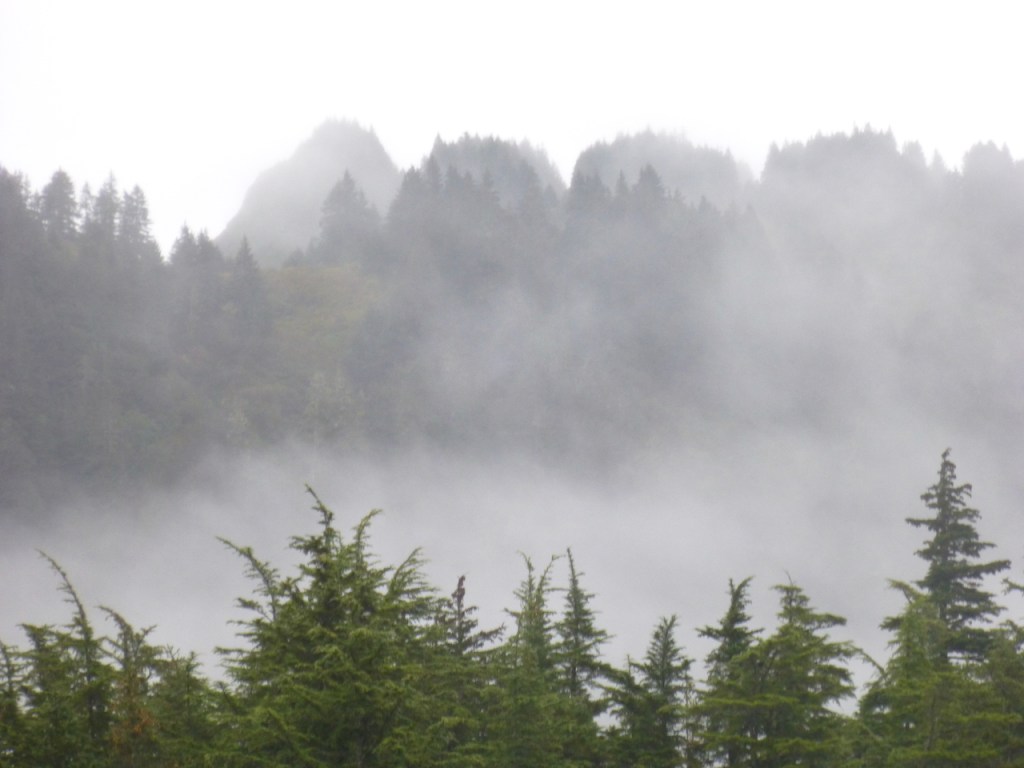
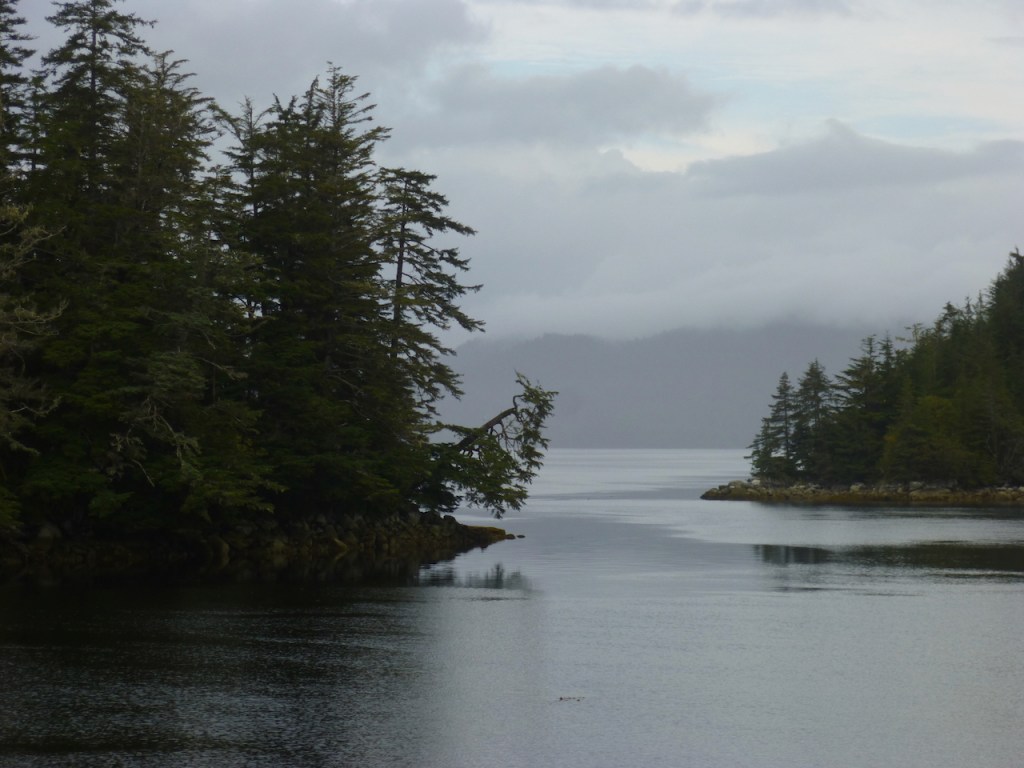
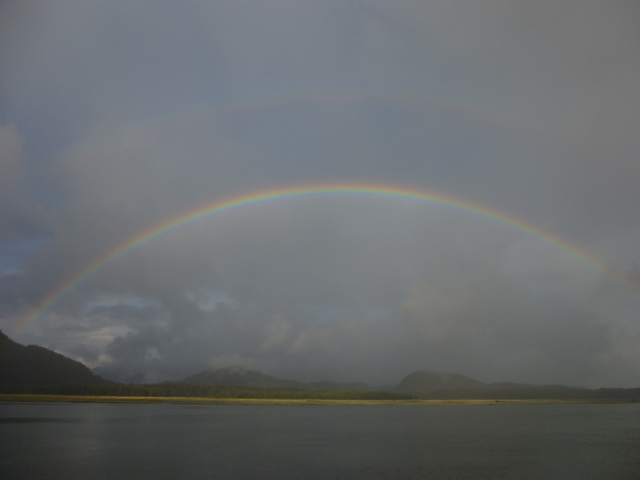
I have visited Southeast Alaska a few times, most notably on an eco-cruise in 2015, just after my beloved mother, who was scheduled to travel with me, made her sudden transition. I heard her voice tell me not to cancel this opportunity, but to take a friend. On the small boat called the Wilderness Discoverer we sailed through Glacier Bay and the northern passages. We kayaked among seals on misty afternoons, and bushwhacked through early fall rainforests. Rainbows and rain followed us gently, eagles sailed the skies, and the blue silence of ancient glaciers magnified our awe.
As someone who has never lived in Alaska yet considers it a second and familiar home, I am always looking for stories about that vast and magic land. As I peruse the Alaska shelves in Mosquito books, my eyes drift past the thrillers and mysteries that dominate, seeking out new voices. Kim Heacox’s books, fiction and non-fiction, will never disappoint.
Debra Denker is the author of Weather Menders, a cli-fi time travel novel for the hopeful.


