The “Escape the thought police” game
When I was a child of perhaps nine years old, my best friend, also named Debbie, and I used to play an odd game called “Escape the Thought Police.” Bear in mind that this was the mid-60s and though we were both reading at adult level by that age, neither of us had yet read 1984 or Brave New World.
We pretended that we were being held prisoner under the spreading branches of the large deodar tree at Debbie’s house, and that the Thought Police were monitoring our every thought, especially those about planning escape, and would electric shock us every time we thought of it. The way out was to look at each other simultaneously without thinking and run like heck for the tree house where we would be forever safe.
I have never met anyone else who played this childhood game, and I have no idea where it came from other than either the collective unconscious noosphere or past life memories of totalitarian societies.
I now think that our escape mechanism is similar to the Buddhist concept of “non-thought.” In Buddhist and other mystical systems, one practices meditation long enough and assiduously enough to, ideally, enter a state of non-thought, which goes by various names. In this eternally present moment, thoughts arise and dissolve, but are never grasped onto. Duality ceases to exist. One is in the Natural State, the Great Completion.
Now that we are living under constant global surveillance capitalism, even in countries that are run by something nominally still called the “Communist Party” as in China, this ability to evade the thought police has renewed relevance in my life.
The Age of Global Surveillance Capitalism
We are all subject to persistent data mining. I used to think it was a synchronistic coincidence if I saw an ad for something I’d just been discussing with a friend, either online or on the phone. Now I know better.
Having grown up in an advertising family, I learned early how to filter out persuasion and how to discern propaganda for a political position or for a product. A high school friend who later worked in our family sales promotion business used to say jokingly that advertising was “the art of selling people things they don’t want, don’t need, and can’t afford.”
My dad, who won a CLIO award for creating the Little Old Lady from Pasadena “put a Dodge in your garage, honey” commercial aired on TV in southern California, was always annoyed, and perhaps a little hurt, at my aversion to advertising. He pointed out, probably quite rightly, that I “wouldn’t have a pot to piss in if it weren’t for advertising,” specifically the family business that made us prosperous by the time I was through with college.
I learned professional film editing at that business, cutting my teeth on new product introductions for Suzuki motorcycles and Toyota cars as I dreamed of making meaningful documentaries that would inspire others to action and open-heartedness. To be fair, my dad was always scrupulous and ethical and turned down accounts if he thought the product or promoter suspect. He and my mom specifically hired for diversity back in the late 70s, and went out of their way to hire models of color to ride those Suzuki motorcycles. This was decades before Black Lives Matter sparked a turning point in advertising, colorblind casting, and Netflix and Amazon movies with characters and families of diverse backgrounds and races.
You Too Can Filter Out Advertising
But creating advertising taught me to filter out advertising. I would mute commercials, and continue to do so on the rare occasions I watch broadcast TV. Amazon Prime probably has me pegged as someone who will eventually grudgingly pay the $3 a month extra (sure to rise) to avoid advertising while watching a movie.
On social media I automatically scroll past all ads (although some for cat products almost get me). On websites, including news media I appreciate such as The Guardian, I ignore all the flashing bits trying to get my attention, and enlarge the text to screen them out.
I have a semi-conscious vow never, never to click on an ad online.
And I learned early on not to take those social media quizzes that suck away one’s time and attention and collect your personal data while providing a passing slight amusement.
Cats Can Game the Algorithm
We are already living in a world dominated by AI and mysterious algorithms. Do “they” think I don’t notice that my social media posts on climate change, biodiversity loss, and genocide get virtually no engagement (or maybe the same five or six people who already agree with me), whereas a short video of one of my cats walking on a leash in snow gets lots of “likes”? I guess I am supposed to somehow use Georgie the Time-traveling Cat from Weather Menders to gain attention for the novel, but it seems to be beyond me to successfully create that brand.

There are days I feel like I’ve landed in some really dystopian sci-fi movie or novel, a visitor from a more advanced society who has come here as part of a mission to help the “dominant” species avoid extinction of themselves and all other life on the planet. And that at the moment we’re not doing so well, and our mission is failing.
So how do we avoid manipulation and “mind control,” and “thought police?” I mean the real threats, not the imaginary ones dreamed up by whoever is cynically creating conspiracy theories about chips in vaccines and poor old George Soros. As always, there is a grain of truth in these conspiracies. Does Big Pharma make horrific profits off of human suffering? Certainly. Are we being surveilled constantly? Ask Ed Snowden, if you can get him to talk to you from Moscow. Or Julian Assange, facing extradition to the US.
I truly don’t know if we can develop our minds finely enough, to a high enough vibration, to keep our unspoken, unshared thoughts private. Can we withstand the mind-reading tech being developed? Can we resist being assimilated by the Borg of late-stage predatory global capitalism?
cats are unpredictable, so be like a cat
In an age of increasing uncertainty, perhaps we can turn this very uncertainty to our advantage. Perhaps we can scramble the data being collected on each and every one of us simply by being consciously unpredictable.
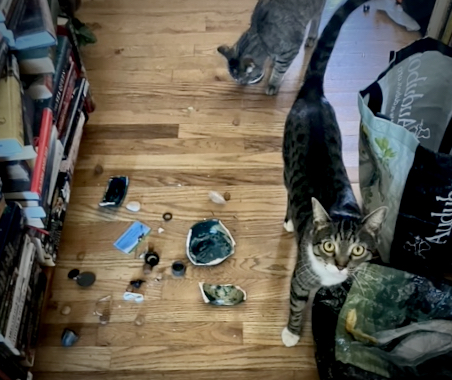
Take the recommendation algorithms for movies , something (relatively) benign. For a long time I couldn’t figure out why Netflix would recommend things I would never watch in a million years, such as violent thrillers. When I housesat for friends, I realized that I was messing up my friend’s husband’s algorithm with the rom-coms and British period dramas I preferred to his action movies. If someone housesat for me, the algorithm tilted a little more towards dark fantasies, cooking shows, or international home buying shows, depending on the housesitter.lF
I began to realize that the only way to trick the algorithm is to be so unpredictable, in some ways so HUMAN, that we defy categorization. Luckily, I have eclectic interests, so this approach comes naturally to me. Instead of watching a string of rom-coms or Christmas movies, I would venture into Japanese anime, an LGBTQ comedy, a Bollywood musical, or an aminated cat film like Puss in Boots. I would intersperse episodes of the horsey family drama Heartland with an occasional war movie, a hospital show like New Amsterdam, a Korean series about an autistic attorney, or a Turkish time-bending mind-bending feminist spiritual fantasy (I don’t know how else to describe The Gift, but I highly recommend it).
I can’t quite venture into scary violent thrillers or horror, but I do occasionally watch a Marvel comics movie, a murder mystery series, or a war film, modern or historical. I will watch documentaries on a variety of subjects, and then switch to quirky French or German police series. And how about a story of a Syrian refugee becoming an Olympic-class swimmer, based on a true story?
Full disclosure: I will watch anything related to the Star Trek series, original and spinoffs. But all the algorithms already know that.
Netflix’s algorithm must surely struggle to determine what I “should” watch with all this variety. I prefer the freedom from the algorithm on PBS Passport, where they just show me what the latest dramas, docs, cooking, and news shows are and I get to scroll through the categories and choose what I’m in the mood for that evening.
AI and algorithms infect so much of our daily lives that we are surely unaware of it most of the time. My swearing and screaming at the Comcast chatbot today only got me into a loop. I called their headquarters and asked to speak to the executive office and finally got a human. He was part of a group of more than a hundred people who are losing their jobs next week, so was more than happy to help me reduce my monthly fee as much as possible.
Be as human as possible, and raise your vibration with kindness
I don’t know what the answer is, or if some massive X-class solar flare really is going to knock out the entire internet, and perhaps a big chunk of the electrical grid with it and solve the problem that way. But the only empowered response I can see to the creeping control of the algorithm is to be as human as possible—as messy, as unpredictable, as compassionate and kind, as mercurial as possible. The US government got my biometrics (without my knowledge or permission) the last time I left the country, so there is nothing I can do about that.
But I can do my best not to become artificial, not to be manipulated, to question everything from mainstream corporate media to conspiracy theories and everything in between. Ultimately, I can only keep focusing on to “raising my vibration” through meditation, clarity of mind, and most of all, kindness—what the Buddhists call Bodhicitta. It is conventionally translated as the “awakened mind” but I prefer “Awakened Heart” from which flows loving-kindness and compassion.
If more of us opt out of pervasive mind control in whatever way we can, perhaps a transformation of our society is still possible. Perhaps we can still achieve what the Sufis call the ensan-e-kamal, the Possible Human. As Possible Humans, we can embrace our true potential through our Natural Intelligence—organic intelligence springing from not just the physical brain but the human mind, and the collective pervasive Mind of all sentient beings on Earth, and Gaia herself.
All is not lost. Be messy. Be unpredictable. Smash the algorithm, and take the dragon of AI by the tail and tame it into the service of goodness, kindness, altruism, and love.
Debra Denker is the author of Weather Menders, a cli-fi time travel novel for the hopeful.

Be Unpredictable and
Smash the Algorithm

 Weather Menders
I wrote a comment and was distracted by Word Press insisting I was using aan ancient accout that my website (never finished) designer used. Then gave me a runarouns because I dont know how she signed up or in Word Press. I assume she used back then , maybe 2006 or so. If i can get into wethermenders any other way please letm mek know. Otherwise i can read what you send and send you a personal message if this is being read by Debra Denker and old friend of mine. If it is not, please letme know si i can email her directly. thanks
>
Chris, is that you? I will send you a link. Do you do Facebook any more? I will email you. You’ve been on my mind as your birthday is near.